Ekinariya Ryokan
| Acidic, Sulfur containing ― Aluminum ― Sulfate / Chloride springs (Hydrogen sulfide type) | pH |
|
| 酸性・含硫黄-アルミニウム-硫酸塩・塩化物泉(硫化水素型) | ||
| (Hypotonic, Acidic, High temperature spring) | ||
| 旧泉質名:- | ||
Ideal for:
- People with skin conditions (e.g., atopic dermatitis)
- People sensitive to cold
- People concerned about dark spots
- People feeling stressed
- Address
- 406, Kusatsu-machi, Agatsuma-gun, Gunma 377-1711, JAPAN
- TEL
- +81-(0)279-88-2005

Official Website

Travel Journal
Hot Spring Power Chart (5-point scale)
※Large Public Bath (for female) “Benten-no-Yu”
Hydrogen Ion Concentration (pH)

- Comment
- Hot spring water with a slight tangy sensation and high antibacterial effect
Hot spring Specification
※This is an easy-to-understand expression based on the indications for each type of spring in the “Guidelines for the Mineral Spring Analysis Methods” revised in July 2014 by the Ministry of the Environment.
| ①Mental recovery | ②Insomnia | ③Promote blood circulation | ④Sensitivity to cold | ⑤Dry skin |
| ⑥Cuts | ⑦Skin diseases | ⑧Hypertension (mild) | ⑨Heartburn (drinking) | ⑩Gastrointestinal disorders (drinking) |
| ⑪Constipation (drinking) | ⑫Lifestyle-related disease | ⑬Diabetes | ⑭Gout | ⑮Countermeasures against metabolic syndrome |
| ⑯Biliary system anxiety (drinking) | ⑰Anaemia | ⑱Arthritis rheumatica | ⑲Spinal pain | ⑳Improved immunity |
| ㉑Muscle pain・Neuralgia | ㉒Mild asthma | ㉓Hemorrhoidal pain | ㉔Recovery from an illness | ㉕Recovery from fatigue |
- ※Note①・・・Indications for each spring include autonomic instability and depression.(Simple springs・Chloride springs・Carbon dioxide springs)
- ※Note③・・・Indications for each spring include peripheral circulatory failure(Chloride springs・Carbonate springs・Carbon dioxide springs・Hydrogen sulfide type sulphur spring)
- ※Note④・・・Indications for each spring include sensitivity to cold(Chloride springs・Carbonate springs・Sulfur springs・Carbon dioxide springs)and Iron containing springs
- ※Note⑦・・・Indications for each spring include xeroderma, atopic dermatitis, plaque psoriasis, epidermoid suppuration, chronic eczema(Chloride springs・Carbonate springs・Sulfate spring・Acidic springs・Sulfur springs)
- ※Note⑨・・・Indications for drinking each spring include reflux esophagitis(Carbonate springs)
- ※Note⑩・・・Indications for drinking each spring include atrophic gastritis, gastroduodenal ulcerations(Chloride springs・Carbonate springs)
- ※Note⑪・・・For drinking, Chloride springs and Sulfate spring
- ※Note⑫・・・Indications for each spring include hypercholesterolemia, diabetes, gout(for bathing, Acidic springs・Radioactive springs/for drinking, Carbonate springs・Iodine containing springs・Sulfur springs)
- ※Note⑮・・・Indications for drinking each spring include hypercholesterolemia(Sulfate spring・Iodine containing springs・Sulfur springs)
- ※Note⑱⑲・・・Indications for each spring include rheumatoid arthritis, ankylosing spondylitis(Radioactive springs)
- ※Note⑳・・・Radioactive springs
- ※Note㉑㉔・・・Simple hot spring water is suitable for rehabilitation due to its low level of stimulation, and although it is not listed as an indication by spring quality, it is also called "Hot spring for neuralgia" and "Hot spring for stroke".
| Applicable to indications by spring quality | Applicable to general indications |
7 Elements of Hot Springs for Beautiful Skin
Total4Points ※The number of points represents the quality of the “Hot springs for beautiful skin”.
| Skin cleansing effect | Anti-wrinkle and skin revitalizing effects | Skin whitening and spot prevention effects |
|---|---|---|
| Hydrogen carbonate springs | Sulfate springs | Sulfur springs |
| Skin smoothing effects | Skin coating and moisturizing effects | Dewy and moisturizing effects | Cleaning effects |
|---|---|---|---|
| (Weak) Alkaline springs | Chloride springs | Metasilicic acid (more than 100 mg/kg) | Metaboric acid (more than 10 mg/kg) |
- ※The “Four Best Beauty Springs” are said to be “Carbonate springs”, “Sulfate springs”, “Sulfur springs”, and “(Weak) Alkaline simple hot springs”.
- ※The “Chloride springs” coats the skin with a salt pack, keeping it warm and moisturized at the same time. It is also called “Hot spring for finishing touch” to be taken after the “Hot spring for beautiful skin” in which exfoliation has been removed.
- ※Hot springs containing 100 mg/kg or more of metasilicicic acid have an excellent moisturizing effect and is said to be “Hot spring for beautiful skin”.
- ※Hot springs containing 10 mg/kg or more of metaboric acid have a cleansing effect, is used in some eye drops, and is said to be effective in treating acne.
Water texture while bathing (5-point evaluation)
| Smooth |  |
 |
|
|
|
Velvety | |
|
|
|
|
|---|---|---|---|---|---|---|---|---|---|---|---|
| Satiny | |
|
|
|
|
Supple | |
|
|
|
|
| Fizzy | |
|
|
|
|
Tingling | |
|
|
|
|
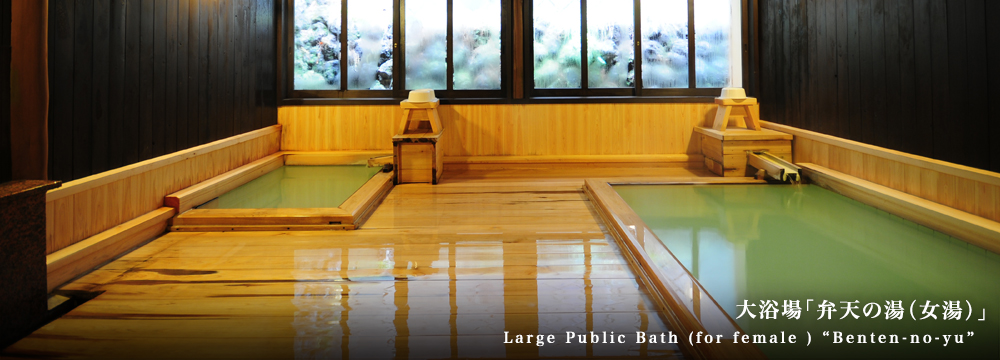
 Indoor bath of the Large Public Bath Indoor bath of the Large Public Bath |
|||||||||||
Skin feeling after bathing (5-point evaluation)

| Silky | |
|
|
|
|
Dryness | |
|
|
|
|
|---|---|---|---|---|---|---|---|---|---|---|---|
| Satiny | |
|
|
|
|
Sticky | |
|
|
|
|
| Dewy | |
|
|
|
|
Warming | |
|
|
|
|
| Indoor bath of the Large Public Bath |
|||||||||||
View from the open-air bath (5-point evaluation)

 View View |
- |
|---|
| Bath |
No open-air baths |
|---|
| Point - |
|---|
Hot Spring Source Usage
| Water added No |
Heated No |
Disinfected No |
Circulated No |
Bath additive No |
|---|---|---|---|---|
| ○ | ○ | ○ | ○ | ○ |
| ※100% natural free-flowing hot spring water. All baths are not circulated, filtered, or disinfected. | ||||
| Percentage of hot spring source |
100% | ||||
|---|---|---|---|---|---|
| Replacement frequency of hot spring water | Large Public Baths・・・Every 5 days Private baths・・・Every 2 days |
||||
| Yield of hot spring water |
Naturally gushing | ||||
| Distance from the source to the bathtub |
Large Public Bath (Shirahata source) - about 100 m Private Bath (Shirahata source) - about 100 m Private Bath (Yubatake source) - about 800 m |
||||
| How hot spring water is drawn | Drawn by a pipe | ||||
| Drinking spring | Cannot | ||||
| “Gensen-Kakenagashi” Bath | All bath | ||||
Hot Spring Composition TableHot Spring Analysis Report
| Spring Quality | Acidic, Sulfur containing ― Aluminum ― Sulfate / Chloride springs (Hydrogen sulfide type)(Hypotonic, Acidic, High temperature spring) 旧泉質名:- |
|---|---|
| Color of hot spring | Clear and colorless Milky white with greenish tinge Milky white with greenish tinge |
| Scent of hot spring | Sulfur smell like rotten eggs |
| Dissolved substances | 1,784 mg/kg ※About 12 to 18 times higher than commercial bath additives! |
| Temperature of spring | Shirahata source: 51.9°C / Yubatake source: 52.3°C (Temperature at the time of survey: 29°C) |
| pH | 2.0 (Acidic) |
| Yield | Shirahata source: 15.1 liters per minute, Yubatake source: 5.41 liters per minute Total 20.42 liters per minute Amount of hot spring use per person (yield / bath capacity):About 1.27 liters/person(maximum capacity of 16 people) |
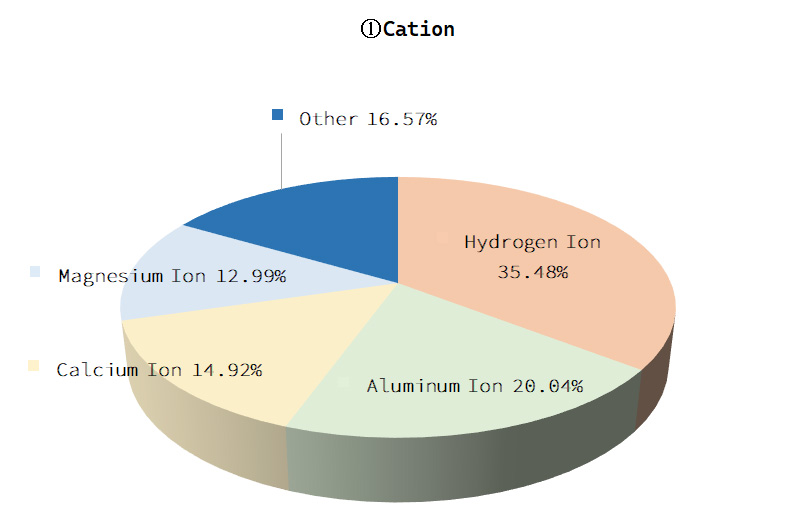
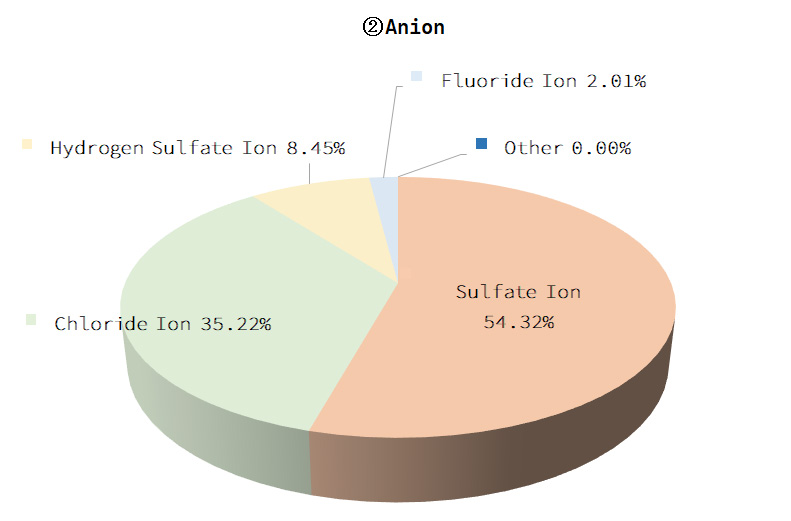
Hot Spring Composition (Amount contained in 1 kg of spring) Shirahata source
 |
|||
|---|---|---|---|
| ①Cation | mg | mval | mval% |
| Hydrogen Ion (H+)★ | 9.3 | 9.26 | 35.48 |
| Aluminum Ion (Al3+)★ | 47.1 | 5.23 | 20.04 |
| Calcium Ion (Ca2+) | 78.0 | 3.89 | 14.92 |
| Magnesium Ion (Mg2+) | 41.2 | 3.39 | 12.99 |
| Sodium Ion (Na+) | 67.0 | 2.91 | 11.13 |
| Potassium Ion (K+) | 26.3 | 0.67 | 2.57 |
| Ferro Ion (Fe2+)★ | 18.5 | 0.66 | 2.54 |
| Manganese Ion (Mn2+) | 1.9 | 0.07 | 0.27 |
| Ammonium Ion (NH4+) | 0.3 | 0.02 | 0.06 |
| Cations Total(1) | 289.6 | 26.10 | 100.00 |
 |
|||
|---|---|---|---|
| ②Anion | mg | mval | mval% |
| Sulfate Ion (SO42-)★ | 685.5 | 14.27 | 54.32 |
| Chloride Ion (Cl-)★ | 328.1 | 9.25 | 35.22 |
| Hydrogen Sulfate Ion (HO4s) | 215.5 | 2.22 | 8.45 |
| Fluoride Ion (F-)★ | 10.0 | 0.53 | 2.01 |
| Anion Total(2) | 1239 | 26.27 | 100.00 |
| ③Undissociated Components | mg | mmol | |
|---|---|---|---|
| Metasilicic Acid (H2SiO3)★ | 240.6 | 3.08 | |
| Metaboric Acid (HBO2)★ | 9.6 | 0.22 | |
| Sulfuric Acid (H2SO4) | 5.1 | 0.05 | |
| Undissociated Components Total(3) | 255.3 | 3.35 | |
| Dissolved Gas Components | mg | mmol | |
|---|---|---|---|
| Free carbon dioxide (CO2) | 29.3 | 0.67 | |
| Free hydrogen sulfide (H2S)★ | 6.4 | 0.19 | |
| Dissolved Gas Components Total(4) | 35.7 | 0.86 | |
| Other Trace Components | |||
|---|---|---|---|
| Lead ion: 0.013 mg/kg, Total arsenic: 0.25 mg/kg |
★are the components related to the “spring quality” and the components that qualify conditions for “Hot spring” and “Therapeutic hot spring”.
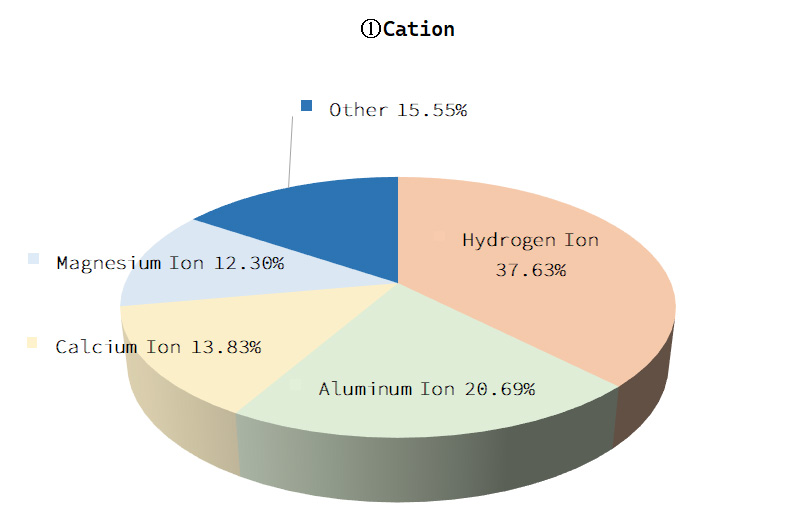
Hot Spring Composition (Amount contained in 1 kg of spring) Yubatake source
 |
|||
|---|---|---|---|
| ①Cation | mg | mval | mval% |
| Hydrogen Ion (H+)★ | 10.0 | 9.92 | 37.63 |
| Aluminum Ion (Al3+)★ | 49.1 | 5.46 | 20.69 |
| Calcium Ion (Ca2+) | 73.1 | 3.65 | 13.83 |
| Magnesium Ion (Mg2+) | 39.4 | 3.24 | 12.30 |
| Sodium Ion (Na+) | 59.7 | 2.60 | 9.85 |
| Potassium Ion (K+) | 30.0 | 0.77 | 2.91 |
| Ferro Ion (Fe2+)★ | 17.8 | 0.64 | 2.41 |
| Manganese(Ⅱ) Ion (Mn2+) | 2.0 | 0.07 | 0.28 |
| Ammonium Ion (NH4+) | 0.5 | 0.03 | 0.10 |
| Cations Total(1) | 281.6 | 26.38 | 100.00 |
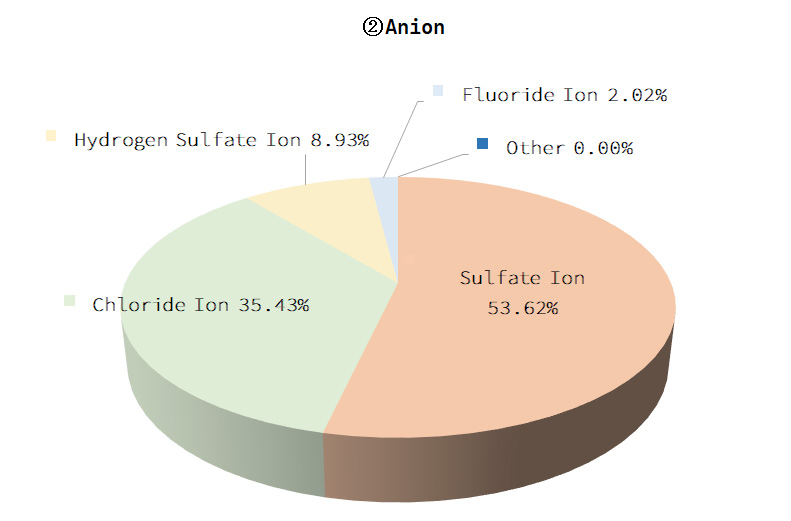 |
|||
|---|---|---|---|
| ②Anion | mg | mval | mval% |
| Sulfate Ion (SO42-)★ | 674.4 | 14.04 | 53.62 |
| Chloride Ion (Cl-)★ | 329.0 | 9.28 | 35.43 |
| Hydrogen Sulfate Ion (HO4s) | 227.1 | 2.34 | 8.93 |
| Fluoride Ion (F-)★ | 10.1 | 0.53 | 2.02 |
| Anion Total(2) | 1241 | 26.19 | 100.00 |
| ③Undissociated Components | mg | mmol | |
|---|---|---|---|
| Metasilicic Acid (H2SiO3)★ | 242.7 | 3.11 | |
| Metaboric Acid (HBO2)★ | 9.8 | 0.22 | |
| Sulfuric Acid (H2SO4) | 5.7 | 0.06 | |
| Undissociated Components Total(3) | 258.2 | 3.39 | |
| Dissolved Gas Components | mg | mmol | |
|---|---|---|---|
| Free carbon dioxide (CO2) | 46.9 | 1.07 | |
| Free hydrogen sulfide (H2S)★ | 6.2 | 0.18 | |
| Dissolved Gas Components Total(4) | 53.1 | 1.25 | |
| Other Trace Components | |||
|---|---|---|---|
| Lead ion: 0.013 mg/kg, Total arsenic: 0.25 mg/kg |
★are the components related to the “spring quality” and the components that qualify conditions for “Hot spring” and “Therapeutic hot spring”.
Indications by Spring Quality for Bathing (Revised on July 1, 2014)
Plaque psoriasis, Impaired glucose tolerance (diabetes), Epidermal suppuration, Atopic dermatitis, Chronic eczema, Cuts, Peripheral circulatory disturbance, Sensitivity to cold, Depression, Dry skin
General Indications for Bathing (Revised on July 1, 2014)
Chronic pains or stiffness of muscles or joints (chronic phase of rheumatoid arthritis, osteoarthritis, lower back pain, nerve pains, frozen shoulder, bruises, sprains, etc.),
Muscle stiffness by motor paralysis, Sensitivity to cold, Peripheral circulatory disturbance,
Gastrointestinal hypofunction (slow digestion, intestinal gas formation, etc.),
Mild hypertension, Impaired glucose tolerance (diabetes), Mild hypercholesterolemia,
Mild asthma or Emphysema, Hemorrhoidal pains, Autonomic instability,
Various symptoms from stress (sleep disorders, depression, etc.),
Restorative phase from illness, Recovery from fatigue, Health promotion
Contraindications by Spring Quality for Bathing (Revised on July 1, 2014)
Hypersensitive skin or mucous membranes, dry skin in the elderly
General Contraindications for Bathing (Revised on July 1, 2014)
Active stage of diseases (especially when fever is accompanied), Active tuberculosis,
Advanced malignant tumor, or the case of significant debility involving severe anemia,
Severe cardiac or lung diseases involving suffocation feelings with a little movement,
Severe kidney disease involving edema, Gastrointestinal bleeding,
When bleeding is visible, Acute exacerbation stage of chronic diseases, etc.
Indications by Spring Quality for Drinking
Not drinkable
Date of Analysis (The above hot spring composition table is cited from the survey data of the following institution)
August 8, 2023 (Gunma Pharmaceutical Association, Environmental Health Testing Center)
- ※Indications and contraindications for hot springs are in accordance with “Guidelines for the Mineral Spring Analysis Methods” revised on July 1, 2014.
- ※Data was provided by the ryokan.
20 qualifications for “Hot spring” and 8 qualifications for “Therapeutic hot spring”
| Conditions/Components (contained amount in 1kg) ※If even one of the conditions is cleared, it is a “Hot spring” or “Therapeutic hot spring” |
A【Hot Springs Act】 Conditions of the “Hot spring” |
B【The Guideline for analysis of Kosen】 Conditions of the “Therapeutic hot spring” |
|
|---|---|---|---|
| 1 | Temperature (when collected from source) | 25℃ or more | |
| 2 | Dissolved substances (excluding gaseous) | Total amount 1,000 mg or more | |
| 3 | Free carbon dioxide (CO2) | 250 mg or more | 1000 mg or more (Carbon dioxide springs) |
| 4 | Lithium Ion (Li+) | 1 mg or more | ― |
| 5 | Strontium Ion (Sr2+) | 10 mg or more | ― |
| 6 | Barium Ion (Ba2+) | 5 mg or more | ― |
| 7 | Total Iron Ion[Fe2+(Iron(Ⅱ) Ferro ion)+Fe3+(Iron(Ⅲ) Ferri ion)] | 10 mg or more | 20 mg or more(Iron containing springs) |
| 8 | First Manganese Ion (Mn2+) | 10 mg or more | ― |
| 9 | Hydrogen Ion (H+) | 1 mg or more | 1 mg or more (Acidic springs) |
| 10 | Bromine Ion (Br-) | 5 mg or more | ― |
| 11 | Iodide Ion (I-) | 1 mg or more | 10 mg or more (Iodine containing springs) |
| 12 | Fluoride Ion (F-) | 2 mg or more | ― |
| 13 | Hydro Arsenate Ion (HAsO42-) | 1.3 mg or more | ― |
| 14 | Meta Arsenite (HAsO2) | 1 mg or more | ― |
| 15 | Total sulfur (S) [HS-(Hydrogen sulfide ion)+S2O32-(Thiosulfate Ion)+H2S(Free hydrogen sulfide)] | 1 mg or more | 2 mg or more (Sulfur springs) |
| 16 | Metaboric acid (HBO2) | 5 mg or more | ― |
| 17 | Metasilicic acid (H2SiO3) | 50 mg or more | ― |
| 18 | Bicarbonate soda (NaHCO3) | 340 mg or more | ― |
| 19 | Radon (Rn) | 20 or more (unit: ten ppb curie) 20×10-10Ci(curie)or more 20 or more(ten ppb curie) =74Bq(becquerel)/5.5mache or more |
30 nanocurie or more(Radioactive springs) 30×10-10Ci(curie)or more 30 or more(ten ppb curie) =111Bq(becquerel)/8.25 macheor more |
| 20 | Radium salt (as Ra) | 10-8mg or more 1/100 million mg or more |
― |
| Number of conditions cleared this “hot spring” or “therapeutic hot spring” is: | 8 (out of 20) | 4 (out of 8) | |
| Total 12 Points | |||
Hot Spring Legends and More
Traditionally documented efficacies
Skin diseases
Historical figures who bathed in this hot spring
Minamoto no Yoritomo, Otani Yoshitsugu, Maeda Toshiie, Kobayashi Issa
Celebrities who bathed in this hot spring
Naoya Shiga, Taro Okamoto
Hot Spring (Onsen) Report
This inn draws from the Shirahata source and the Yubatake source, two of the representative spring sources of Kusatsu Onsen. Both spring qualities are “Acidic, Sulfur containing ― Aluminum ― Sulfate / Chloride springs (Hydrogen sulfide type)”.
In Japan, hot springs are classified into 10 types, of which “Acidic spring”, “Sulfur spring”, “Sulfate spring”, and “Chloride spring”, which means this spring has the characteristics of 4 different types of hot springs.
First, one of the conditions for “Acidic spring” is that 1 mg or more of hydrogen ions must be contained in 1 kg of hot spring water. The pH value (hydrogen ion concentration) of this hot spring is 2.0, which is acidic, and is often shows strong acidity.
With its extremely high antibacterial power, it is effective against atopic dermatitis, trichomonas vaginalis, and athlete's foot, and is called “Hot springs for skin diseases” because it widely removes the causes of problems on the surface of the skin.
Also, the indications by spring quality include Plaque psoriasis, Impaired glucose tolerance (diabetes), and Epidermal suppuration.
It is curious that the color of the hot spring water right after it gushes out from the source is clear and colorless, but it appears milky emerald green, as seen in the Yubatake source. In fact, the cause of this color is said to be related to a microorganism called “Ideyukogome (cyanidiophyceae)”. It is a single cell that prefers the harsh environment of acidic hot water and is a type of algae, and it is said that Kusatsu hot spring area is the best breeding place for it in Japan.
Next, a “Sulfur spring” must contain at least 2 mg of total sulfur (the sum of (1) Hydrogen sulfide ion, (2) Thiosulfate ion, and (3) Free hydrogen sulfide) in 1 kg of hot spring water. There are two types of Sulfur springs: “Sulfur type”, which consists mainly of (1) + (2), and “Hydrogen sulfide type”, which contains more (3). Here in Kusatsu Onsen, it is a “Hydrogen sulfide type - Sulfur spring”.
The color of the water is often milky white, and the indications by spring quality have much in common with “Acidic spring”: Atopic dermatitis, Plaque psoriasis, Chronic eczema, Epidermal suppuration, and Peripheral circulatory disturbance.
The “Sulfur spring” has a high antibacterial effect like the “Acidic spring”, and is said to be “Hot springs for skin diseases” for all skin surface problems, but it also removes excess sebum, making it a good match for people prone to acne and those with oily skin. It is also called “Hot springs for prevention of spots” because it suppresses the production of melanin, the substance that causes spots, and can be expected to have a whitening effect as well. In other words, “Sulfur spring” is a typical “Hot springs for beautiful skin”.
In addition, it is sometimes called “Hot springs for phlegm” because it relieves asthma and improves the sharpness of phlegm.
One thing to keep in mind is that metal rings and necklaces must be removed when bathing, as the sulfur component can cause discoloration.
Contraindications by spring quality for bathing includes hypersensitive skin or mucous membranes, and dry skin in the elderly (※same as Acidic spring).
In other words, “Sulfur springs”, like “Acidic spring”, are highly stimulating springs, so the sickly, elderly, and those with weak skin should be careful and are prone to “Hot spring fatigue”. Many of the best hot springs are a combination of “Acidic spring” - Hot spring for antibacterial and “Sulfur spring (Hydrogen sulfide type)” - Hot spring for beautiful skin. However, please keep in mind that the stronger the efficacy, the more stressful it is on the skin.
One of the conditions for a “Sulfate spring” is that the main component of the anion is the sulfate ion.
The indications by spring quality for bathing are Cuts, Peripheral circulatory disturbance, Sensitivity to cold, Depression, and Dry skin.
The “Hot Spring Analysis Report” shows that the cations are rich in aluminum ions, which are combined with sulfate spring water to make the former name of the spring, “Myoban-sen (Alum spring)”. Its so-called convergence action, which shrinks tissues and blood vessels by denaturing proteins, tightens the skin, activates metabolism, and promotes skin revitalization. Therefore, it is effective for cuts, burns, acne, psoriasis, itching, and chronic eczema, and is therefore also called “Hot springs for cuts”.
In addition, the “Sulfate spring” is highly effective for oily skin because of its ability to wash away excess oil from the skin.
Also, the sulfate ions have the effect of pumping more oxygen into the blood and rehydrating the skin, making it taut and moisturized, which is an anti-aging effect. This is why it is called “Hot springs for rejuvenation”. Like sulfur spring, it is also known as a “Hot springs for beautiful skin”.
Finally, the “Chloride spring” has the same five indications as the “Sulfate spring”, including Cuts, Peripheral circulatory disturbance, Sensitivity to cold, Depression, and Dry skin.
The salt has antibacterial effects, so it is a typical “Hot springs for cuts”.
A “Chloride spring” is also sometimes referred to as a “Hot springs for warmth”. This is because the salts in the spring water adhere to the skin and form a film, which works like a pack to block the sweat glands after the bath, preventing the body temperature from dropping due to sweating. Because of the warming effect and the long-lasting warmth, Peripheral circulatory disturbance and Sensitivity to cold are recognized as indications. Although Sensitivity to cold is also an indication for other types of springs, the “Chloride spring” is considered to be particularly effective.
This hot spring pack is also effective as an indication for Dry skin because it prevents skin from drying out after the bath. And, as with “Sulfate springs”, the fact that Depression is recognized as an indication by spring quality is probably due to the low-irritant character of the spring, compared to “Acidic spring” and “Sulfur spring”.
The amount of “Metasilicic acid”, a non-dissociated component other than cations and anions, is also noteworthy.
More than 200 mg of metasilicic acid is contained per kilogram of spring water, which is four times higher than the standard value for hot springs (50 mg/kg). Metasilicic acid is used as an ingredient in some lotions and has moisturizing effects. Hot springs with high metasilicic acid content can be called “Hot springs for beautiful skin”.
Furthermore, the amount of “Metaboric acid” is also amazing. This also contains almost double the standard value (5 mg/kg) for hot springs.
It has a cleansing effect, is used in some eye drops, and is said to be effective against acne.
The quality of the hot spring water in this inn is of such a high quality that it deserves to be called a “Famous hot spring in Japan”, but it is also used in a very thorough manner.
The bathhouse does not use circulation, filtration, or disinfection, but always pours “100% natural hot spring water” into the bathtub, which is then overflowed and replaced with new hot spring water. The innkeepers also adjust the amount of hot spring water poured into the bathtub from the hot water outlet, taking into account the temperature of the day, to keep the water at the proper temperature.
Kusatsu Onsen boasts the largest amount of naturally gushing hot spring water in Japan, which means that no motors are used to pump the spring water up from underground. The overflow of hot spring water from a source close to the surface of the earth means that there is little possibility of impurities entering the water. The ingredients of the hot spring are also very high, as you can see above.
We hope you will experience the blessings of nature and the gifts of the earth to your heart's content.
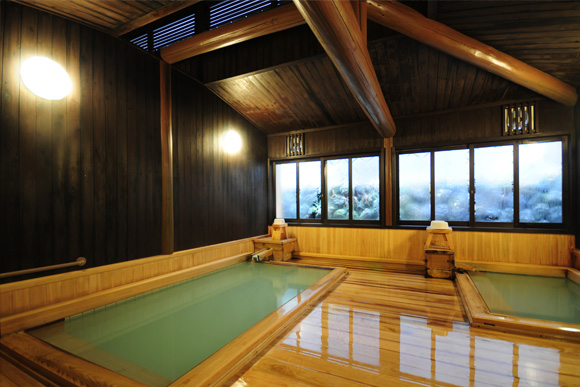
| Large Public Bath “Benten-no-Yu” men's bath | Large Public Bath “Benten-no-Yu” hot spring outlet |
|---|---|
 |
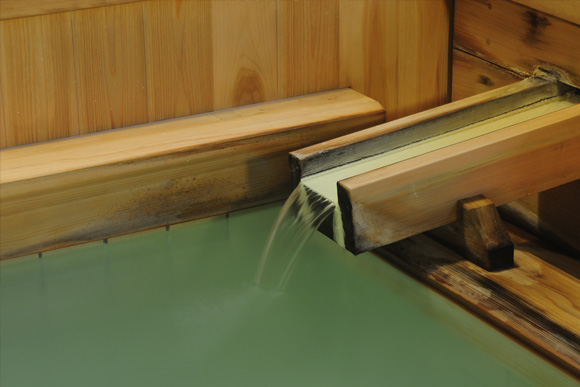 |
| The luxurious hinoki cypress bathtub in the large public bath “Benten-no-Yu” is an eye-catching feature of the inn. The inn has only six guest rooms, and even when the rooms are full, the baths are rarely crowded due to the availability of private baths. | The men's and women's large public bath “Benten-no-Yu” draws water from the Shirahata source, which is representative of Kusatsu Onsen. The milky emerald green water from the source provides an exquisite bathing experience. |
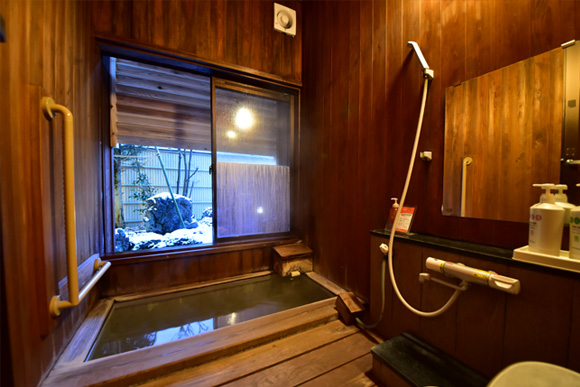
| Private bath “Ruri-no-Yu” | Private bath “Seki-no-Yu” |
 |
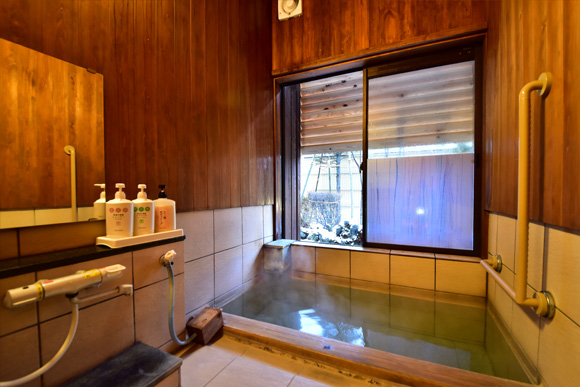 |
| There are six private baths offered per guest room, the same as the number of guest rooms. Two of these, “Ruri-no-Yu” and “Chiyo-no-Yu”, draw from the “Shirahata source”. You can have the famous hot water all to yourself in these baths. | The other four “Seki-no-Yu” here, as well as “Netsu-no-Yu”, “Taka-no-Yu”, and “Matsu-no-Yu”, use “Yubatake source”. Although small, these baths are valuable in that guests can bathe at any time of the day without any hesitation. |
Facility Report
Kusatsu Onsen, located at the eastern foot of the active volcano Mount Kusatsu-Shirane, is known as one of Japan's most famous hot spring areas, even more than as a notable spot within Gunma Prefecture. In the Edo period (1603-1868), Kusatsu Onsen was ranked at the highest level (Ozeki) in eastern Japan in the Onsen Banzuke, which was based on the Sumo Banzuke (a ranking chart for sumo wrestlers). Dr. Bälz of Germany, who came to Japan during the Meiji period (1868-1912) and is known as the “father of modern medicine” in Japan, loved the cold climate at an altitude of 1200 ⅿ and the highly acidic waters of Kusatsu Onsen, which is rare in Europe. He later studied the onsen's mineral composition and promoted the benefits of onsen therapy. Even today, Kusatsu Onsen remains Japan's most popular hot spring resort under the theme of "onsen-ism" and is highly regarded not only for its springs but also for the town built around the Yubatake hot spring field. There are several hot spring sources, such as the “Bandaikou source” (6020 l/min), “Yubatake source” (4040 l/min), “Sainokawara source” (1073 l/min), “Nikawa source” (817 l/min), “Shirahata source” (659 l/min), “Netsu-no-Yu source” (298 l/min) and “Jizou source” (252 l/min). Each is among the most highly acidic springs in Japan. Altogether, the hot spring sources produce 32,300 liters of water per minute, which is the largest natural hot spring flow rate in Japan, without any motorized pumping from underground. Ekinariya Ryokan is ideally located, just a minute's walk from Yubatake source, the symbol of Kusatsu Onsen. The inn uses two types of sources: “Shirahata source” and “Yubatake source”. The Shirahata source is said to have been discovered and bathed in by Minamoto no Yoritomo (1147-1199), the shogun who founded the Kamakura Shogunate, during his visit to Kusatsu in 1193. Near the Yubatake source, the largest public hot spring in Kusatsu Onsen, “Shirahata-no-Yu” also draws from this source. This small ryokan has a total of six rooms, but its unique feature is that each room has its own private onsen bath. In other words, each room has its own private hot spring bath that no other guests can enter until check-out. The owner herself handles the kitchen knives and serves the food to the guests. The inside of the inn is decorated with pressed flower art created by the landlady, creating a serene, relaxing atmosphere. Due to its small size, this hot spring inn allows guests to fully enjoy Japan's famous hot springs in a peaceful and intimate setting.
Travel Journal
Rates Data
| 1 night / 2 meals fee | From 24,350 yen |
|---|---|
| Private bath fee when overnight stay |
Free for overnight guests |
| Day stay | Unavailable now |
| Private bath for day-stay |
Unavailable now |
Facility Data
| Establishment | Established in 1969 |
|---|---|
| Check-In | 2:00 p.m. |
| Check-Out | 10:00 a.m. |
| Number of Rooms | All 6 rooms (Japanese style) |
| Number of People Accommodated |
16 persons |
| Parking Area | Available for 6 cars |
| Facilities | Shop |
| Internet | Wi-Fi available |
| Barrier Free | Not supported |
| Toilet with washer | Equipped in all guest rooms |
Transportation Access
| By train | JR Ueno station, Joetsu, Azuma line, New limited express Kusatsu → JR Nagano Kusatsuguchi station in about 3 hours → JR bus for Kusatsu Onsen → about 25 min., JR Kusatsu Onsen bus terminal → 5 min. by walk |
|---|---|
| By bus | JR highway bus Jyoshu Yumeguri-go at Basta Shinjuku → about 4 hours, JR Kusatsu Onsen bus terminal → 5 min. by walk |
| By car | Kanetsu Expressway, Nerima IC → about 3 hours, exit at Shibukawa-Ikaho IC → Use Route 17, 353, 145, or 292 |
| Address | Gunma/Kusatsu Onsen/Ekinariya Ryokan 406, Kusatsu-machi, Agatsuma-gun, Gunma 377-1711, JAPAN Phone:+81-(0)279-88-2005 |
- Data
- Jan. 22, 2026