Echigo-Nagano Onsen RANKEISOU
| Sodium - Chloride cold mineral springs | pH |
|
| ナトリウムー塩化物冷鉱泉 | ||
| (Isotonic, Weakly alkaline, Cold mineral spring) | ||
| Former spring quality: Salt cold mineral springs | ||
Ideal for:
- People interested in skin-beautifying effects
- People with dry skin
- People with minor cuts
- People looking to relax and relieve stress
- People sensitive to cold
- People who enjoy a refreshing post-bath feeling
- Address
- 1450 Nagano, Sanjo City, Niigata 955-0132, JAPAN
- TEL
- +81-(0)256-47-2211

Official Website

Travel Journal
| Source | Status of Source Utilization | |
|---|---|---|
| Status of Source Emergence |
Hot Spring Power Chart (5-point scale)
Hydrogen Ion Concentration (pH)

- Comment
- Gently exfoliates dead skin cells, leaving your skin smooth and silky!
Hot spring Specification
※This is an easy-to-understand expression based on the indications for each type of spring in the "Guideline to the Mineral Spring Analysis Methods" revised in July 2014 by the Ministry of the Environment.
| ①Mental recovery | ②Insomnia | ③Promote blood circulation | ④Sensitivity to cold | ⑤Dry skin |
| ⑥Cuts | ⑦Skin diseases | ⑧Hypertension (mild) | ⑨Heartburn (drinking) | ⑩Gastrointestinal disorders (drinking) |
| ⑪Constipation (drinking) | ⑫Lifestyle-related disease | ⑬Diabetes | ⑭Gout | ⑮Countermeasures against metabolic syndrome |
| ⑯Biliary system anxiety | ⑰Anaemia | ⑱Arthritis rheumatica | ⑲Spinal pain | ⑳Improved immunity |
| ㉑Muscle pain・Neuralgia | ㉒Mild asthma | ㉓Hemorrhoidal pain | ㉔Recovery from an illness | ㉕Recovery from fatigue |
- ※Note①・・・Indications for each spring include autonomic instability and depression.(Simple springs・Chloride springs・Carbon dioxide springs)
- ※Note③・・・Indications for each spring include peripheral circulatory failure(Chloride springs・Carbonate springs・Carbon dioxide springs・Hydrogen sulfide type sulphur spring)
- ※Note④・・・Indications for each spring include sensitivity to cold(Chloride springs・Carbonate springs・Sulfur springs・Carbon dioxide springs)and Iron containing springs
- ※Note⑦・・・Indications for each spring include xeroderma, atopic dermatitis, plaque psoriasis, epidermoid suppuration, chronic eczema(Chloride springs・Carbonate springs・Sulfate spring・Acidic springs・Sulfur springs)
- ※Note⑨・・・Indications for drinking each spring include reflux esophagitis(Carbonate springs)
- ※Note⑩・・・Indications for drinking each spring include atrophic gastritis, gastroduodenal ulcerations(Chloride springs・Carbonate springs)
- ※Note⑪・・・For drinking, Chloride springs and Sulfate spring
- ※Note⑫・・・Indications for each spring include hypercholesterolemia, diabetes, gout(for bathing, Acidic springs・Radioactive springs/for drinking, Carbonate springs・Iodine containing springs・Sulfur springs)
- ※Note⑮・・・Indications for drinking each spring include hypercholesterolemia(Sulfate spring・Iodine containing springs・Sulfur springs)
- ※Note⑱⑲・・・Indications for each spring include rheumatoid arthritis, ankylosing spondylitis(Radioactive springs)
- ※Note⑳・・・Radioactive springs
- ※Note㉑㉔・・・Simple hot spring water is suitable for rehabilitation due to its low level of stimulation, and although it is not listed as an indication by spring quality, it is also called "Hot springs for neuralgia" and "Hot springs for stroke".
| Applicable to indications by spring quality | Applicable to general indications |
7 Elements of Hot Springs for Beautiful Skin
Total 4 Points ※The number of points represents the quality of the "Hot springs for beautiful skin".
| Skin cleansing effect | Skin reviving effect | Skin whitening effect |
|---|---|---|
| Carbonate Springs | Sulfate Springs | Sulfur Springs |
| Skin smoothing effect | Skin coating and moisturizing effect | Skin moisturizing effect | Cleaning effects |
|---|---|---|---|
| Weak alkaline | Chloride springs | Metasilicic acid (100mg/kg) |
Metaboronic acid (10mg/kg) |
- ※The "Four Best Beauty Springs" are said to be "Carbonate springs", "Sulfate springs", "Sulfur springs", and "(Weak) Alkaline simple hot springs".
- ※The "Chloride springs" coats the skin with a salt pack, keeping it warm and moisturized at the same time. It is also called "Hot springs for finishing touch" to be taken after the "Hot spring for beautiful skin" in which exfoliation has been removed.
- ※Hot springs containing 100 mg/kg or more of metasilicicic acid have an excellent moisturizing effect and is said to be "Hot springs for beautiful skin".
- ※Hot springs containing 10 mg/kg or more of metaboric acid have a cleansing effect, is used in some eye drops, and is said to be effective in treating acne.
Water texture while bathing (5-point evaluation)
| Smooth |  |
|
|
|
 |
Velvety | |
|
|
|
|
|---|---|---|---|---|---|---|---|---|---|---|---|
| Satiny | |
|
|
|
|
Supple | |
|
|
|
|
| Fizzy | |
|
|
|
|
Tingling | |
|
|
|
|
 Based on Large Public Baths Based on Large Public Baths |
|||||||||||
Skin feeling after bathing (5-point evaluation)

| Silky | |
|
|
|
|
Dryness | |
|
|
|
|
|---|---|---|---|---|---|---|---|---|---|---|---|
| Satiny | |
|
|
|
|
Sticky | |
|
|
|
|
| Dewy | |
|
|
|
|
Warming | |
|
|
|
|
| Based on Large Public Baths |
|||||||||||
View from the open-air bath(5-point evaluation)

 View View |
Mountain, Valley, Mountain stream |
|---|
| Bath |
Open-Air Baths in the Large Public Baths |
|---|
 |
|
|
|
Point 4 |
|---|
Hot Spring Source Usage
| Water added No |
Heated No |
Disinfected No |
Circulated No |
Bath additive No |
|---|---|---|---|---|
| ○ | × | △ | × | ○ |
| ※Heated because of the low temperature of the hot spring source ※Circulated to maintain the bathing temperature and protect the hot spring resource ※A solid chlorine disinfectant is added once a day after check-out |
||||
| Percentage of hot spring source | 100% | ||||
|---|---|---|---|---|---|
| Replacement frequency of hot spring water | The water is completely replaced approximately once every 3–7 days | ||||
| Yield of hot spring water | Pumped from two private hot spring sources (100 m underground) using the air-lift method | ||||
| Distance from the source to the bathtub | Within 100 m (the hot spring source is located on the property) | ||||
| How hot spring water is drawn | Private hot spring source. Managed in a storage tank on the property | ||||
| How water temperature is adjusted | Because the source temperature is low, the water is heated using a circulation system | ||||
| Drinking Spring | Drinking the hot spring water is not permitted in the bath area. In the lobby, however, you can enjoy Hojicha brewed with the natural spring water |
||||
| “Gensen-Kakenagashi” Bath | - | ||||
Hot Spring Composition Table Hot Spring Analysis Report
| Spring Quality | Sodium - Chloride cold mineral springs (Isotonic, Weakly alkaline, Cold mineral spring) Former spring quality: Salt cold mineral springs |
|---|---|
| Color of hot spring | Clear and colorless |
| Scent of hot spring | Odorless |
| Dissolved substances | 8,739 mg/kg (Sum of components (1) + (2) + (3), excluding gaseous substances) |
| Temperature of spring | 15.0℃ (At the time of the survey: 8°C) |
| pH | 7.9 (Weakly alkaline) |
| Yield | About 48 liters per minute Amount of hot spring use per person (yield / bath capacity):About 0.8 liters/person(maximum capacity of 60 people) |
Hot Spring Composition (Amount contained in 1 kg of spring)
 |
|||
|---|---|---|---|
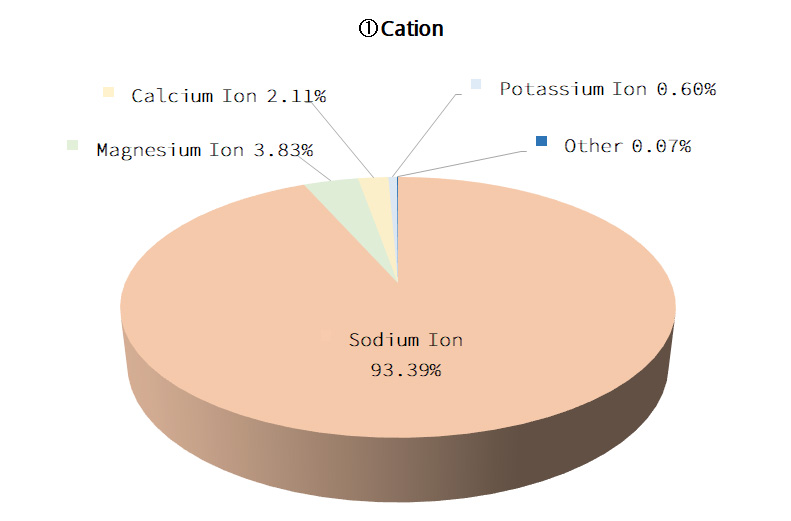
| ①Cation | mg | mval | mval% |
| Sodium Ion(Na+)★ | 2957 | 128.6 | 93.39 |
| Magnesium Ion(Mg2+) | 64.1 | 5.27 | 3.83 |
| Calcium Ion(Ca2+) | 58.4 | 2.91 | 2.11 |
| Potassium Ion(K+) | 32.5 | 0.83 | 0.60 |
| Lithium Ion(Li+) | 0.3 | 0.04 | 0.03 |
| Strontium Ion(Sr2+) | 0.3 | 0.01 | 0.01 |
| Barium Ion(Ba2+) | 0.3 | 0.00 | 0.00 |
| Manganese Ion(Mn2+) | 0.3 | 0.01 | 0.01 |
| Aluminum Ion(Al3+) | <0.1 | - | - |
| Ammonium Ion(NH4+) | <0.1 | - | - |
| Ferro Ion(Fe2+) | <0.1 | 0.00 | 0.00 |
| Ferri Ion(Fe3+) | <0.1 | - | - |
| Copper Ion(Cu+) | <0.1 | - | - |
| Cations Total① | 3113 | 137.7 | 100.00 |
 |
|||
|---|---|---|---|
| ②Anion | mg | mval | mval% |
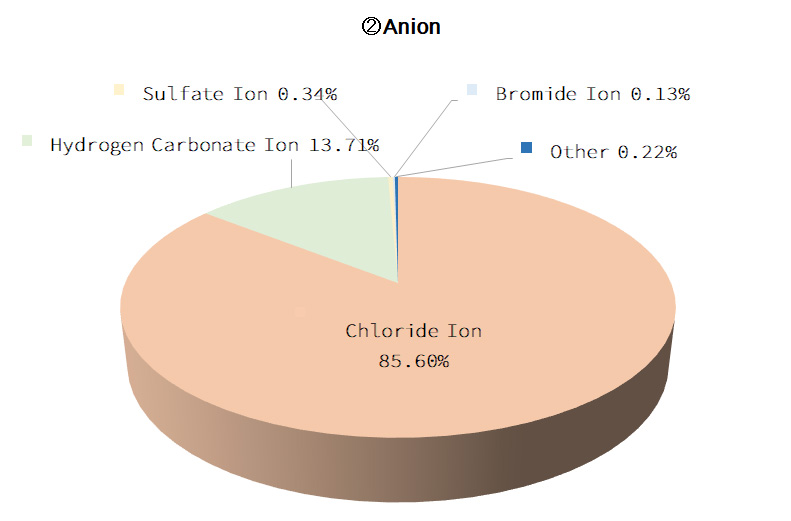
| Chloride Ion(Cl-)★ | 4322 | 121.9 | 85.60 |
| Hydrogen Carbonate Ion(HCO3-)★ | 1191 | 19.52 | 13.71 |
| Sulfate Ion(SO42-) | 23.3 | 0.49 | 0.34 |
| Bromide Ion(Br-)★ | 15.5 | 0.19 | 0.13 |
| Carbonate Ion(CO32-) | 7.2 | 0.24 | 0.17 |
| Iodide Ion(I-)★ | 1.4 | 0.01 | 0.01 |
| Fluoride Ion(F-) | 0.3 | 0.02 | 0.01 |
| Hydrosulfide Ion(HS-) | <0.1 | - | - |
| Sulfide Ion(S2-) | <0.1 | - | - |
| Thiosulfate Ion(S2O32-) | 0.4 | 0.01 | 0.00 |
| Hydrogen Sulfate Ion(HSO4-) | <5.0 | - | - |
| Anions Total② | 5561 | 142.4 | 100.00 |
| Undissociated Components | mg | mmol | |
|---|---|---|---|
| Metasilicic Acid(H2SiO3) | 42.0 | 0.54 | |
| Metaboric Acid(HBO2)★ | 22.7 | 0.52 | |
| Meta-arsenic Acid(HAsO2) | <0.1 | - | |
| Undissociated Components Total③ | 64.7 | 1.06 | |
| Dissolved Gas Components | mg | mmol | |
|---|---|---|---|
| Free Carbon Dioxide(CO2) | 25.1 | 0.57 | |
| Free Hydrogen Sulfide(H2S) | <0.1 | - | |
| Dissolved Gas Components Total④ | 25.1 | 0.57 | |
| Other Trace Components | |||
|---|---|---|---|
| Not detected (Lead: 0.005 mg/kg, Cadmium Ion: 0.005 mg/kg, Total Arsenic: 0.005 mg/kg, Total Mercury: 0.0002 mg/kg) |
★are the ingredients related to the "spring quality" and the ingredients that qualify conditions for "hot spring" and "therapeutic hot spring".
Indications for Bathing (Revised on July 1, 2014)
Indications by Spring Quality for Bathing
Cuts, Peripheral circulatory disturbance, Sensitivity to cold, Depression, Dry skin
General Indications for Bathing
Chronic pain or stiffness of muscles or joints (chronic phase of rheumatoid arthritis, osteoarthritis, lower back pain, neuralgia, frozen shoulder, bruises, sprains, etc.),
muscle stiffness by motor paralysis, sensitivity to cold, peripheral circulatory disturbance,
gastrointestinal hypofunction (slow digestion, intestinal gas formation, etc.),
mild hypertension, impaired glucose tolerance (diabetes), mild hypercholesterolemia,
mild asthma or emphysema, pains of hemorrhoidals, autonomic instability,
various symptoms from stress (sleep disorders, depression, etc.),
restorative phase from illness, recovery from fatigue, health promotions
Contraindications by Spring Quality for Bathing
None
General Contraindications for Bathing
Active stage of diseases (especially when fever is accompanied), active tuberculosis,
advanced malignant tumor, or the case of significant debility involving severe anemia,
severe cardiac or lung diseases involving suffocation feelings with a little movement,
severe kidney disease involving edema, gastrointestinal bleeding,
when there is visible bleeding, acute exacerbation stage of chronic diseases, etc.
Indications by Spring Quality for Drinking
The hot spring water is not approved for drinking by the local health authority
*However, Hojicha brewed with the spring water is served in the lobby, and hot spring rice porridge is offered at breakfast
Date of Analysis (The above hot spring composition table is cited from the survey data of the following institution)
December 16, 2024 (Niigata Prefectural Central Institute of Environmental Hygiene)
- ※Indications and contraindications for hot springs are in accordance with "Guideline to the Mineral Spring Analysis Methods" revised on July 1, 2014.
- ※Data was provided by the ryokan.
20 qualifications for "Hot springs" and 8 qualifications for "Therapeutic hot springs"
| Conditions/Components (contained amount in 1 kg) ※If even one of the conditions is cleared, it is a "Hot springs" or "Therapeutic hot springs" |
A【Hot Springs Act】 Conditions of the "Hot springs" |
B【Guideline to the Mineral Spring Analysis Methods】 Conditions of the "Therapeutic hot springs" |
|
|---|---|---|---|
| 1 | Temperature (when collected from source) | 25℃ or higher | |
| 2 | Dissolved Substances (excluding gaseous) | Total amount 1,000 mg or more | |
| 3 | Free Carbon Dioxide (CO2) | 250 mg or more | 1000 mg or more (Carbon dioxide springs) |
| 4 | Lithium Ion (Li+) | 1 mg or more | ― |
| 5 | Strontium Ion (Sr2+) | 10 mg or more | ― |
| 6 | Barium Ion (Ba2+) | 5 mg or more | ― |
| 7 | Total Iron Ion[Fe2+(Iron(Ⅱ) Ferro Ion)+Fe3+(Iron(Ⅲ) Ferri Ion)] | 10 mg or more | 20 mg or more(Iron containing springs) |
| 8 | First Manganese Ion (Mn2+) | 10 mg or more | ― |
| 9 | Hydrogen Ion (H+) | 1 mg or more | 1 mg or more (Acidic springs) |
| 10 | Bromine Ion (Br-) | 5 mg or more | ― |
| 11 | Iodide Ion (I-) | 1 mg or more | 10 mg or more (Iodine containing springs) |
| 12 | Fluoride Ion (F-) | 2 mg or more | ― |
| 13 | Hydro Arsenate Ion (HAsO42-) | 1.3 mg or more | ― |
| 14 | Meta-arsenic Acid (HAsO2) | 1 mg or more | ― |
| 15 | Total sulfur (S) [HS-(Hydrogen Sulfide Ion)+S2O32-(Thiosulfate Ion)+H2S(Free Hydrogen Sulfide)] | 1 mg or more | 2 mg or more (Sulfur springs) |
| 16 | Metaboric Acid (HBO2) | 5 mg or more | ― |
| 17 | Metasilicic Acid (H2SiO3) | 50 mg or more | ― |
| 18 | Sodium Hydrogen Carbonate (Sodium Bicarbonate)(NaHCO3) |
340 mg or more | ― |
| 19 | Radon (Rn) | 20 or more (unit: ten ppb curie) 20×10-10Ci(curie) or more 20 or more(ten ppb curie) =74Bq(becquerel) / 5.5mache or more |
30 nanocurie or more (Radioactive springs) 30×10-10Ci(curie) or more 30 or more(ten ppb curie) =111Bq(becquerel) / 8.25 macheor more |
| 20 | Radium Salt (as Ra) | 10-8 mg or more 1/100 million mg or more |
― |
| Number of conditions cleared this "hot spring" or "therapeutic hot spring" is: | 4 | 1 | |
| Total 6 Points | |||
Hot Spring Legends and More
Traditionally documented efficacies
It was sold as a medicinal remedy for skin diseases, cuts, sensitivity to cold, women's health conditions, neuralgia, stiff shoulders, and recovery after illness.
Historical figures who bathed in this hot spring
Tetsuji Morohashi (1883–1982), editor-in-chief of the Daikanwa Dictionary
Celebrities who bathed in this hot spring
Koki Mitani, Toshiyuki Nishida, Ken Watanabe, and Satomi Kobayashi (Rankeisou was also used as a filming location for the NHK 50th Anniversary drama “The River, Someday to the Sea”)
Hot Spring (Onsen) Report
The spring quality of Rankeisou is classified as Sodium - Chloride cold mineral springs.
Its main components are Sodium Ions (cations) and Chloride Ions (anions). This spring type is commonly known in Japan as a “Hot springs for warmth”. The salt contained in the hot spring water adheres to the skin, forming a thin protective layer that acts like a natural salt pack. This layer helps reduce heat loss by preventing sweat from evaporating too quickly, allowing the body to stay warm long after bathing. For this reason, it is considered beneficial for people with Sensitivity to cold.
In addition, Sodium – Chloride springs help dilate blood vessels and improve blood circulation, making them beneficial for Peripheral circulatory disturbance. Their excellent heat-retaining properties are also believed to help regulate the autonomic nervous system, contributing to the improvement of Depression.
This spring is also known as “Hot springs for cuts” because its salt content has bactericidal properties, making it beneficial for Cuts.
The combination of sodium and chloride ions provides a moisturizing effect, helping to lock moisture into the skin and making it beneficial for people with Dry skin.
(*Text in blue indicates Indications for bathing in this spring quality)
Compared with the many hot springs found throughout Japan, the spring at Rankeisou is truly exceptional.
One of the main reasons is its remarkably high concentration of dissolved substances.
According to the official Hot Spring Analysis, the total amount of dissolved substances is 8,739 mg/kg!
Under Japan's Hot Springs Act, one of the criteria for qualifying as a therapeutic hot spring is a total dissolved substance content of 1,000 mg/kg or more (excluding gaseous substances). At 8,739 mg/kg, Rankeisou's spring contains more than 8 times the required minimum.
In other words, it is an exceptionally “highly” concentrated hot spring, a rarity even by Japanese standards.
For comparison, the famous Yubatake Source at Kusatsu Onsen contains approximately 1,780 mg/kg of dissolved substances.
Even this renowned hot spring has only about one-fifth of the dissolved substance content found at Rankeisou, highlighting just how extraordinary this spring truly is.
Further evidence of Rankeisou's exceptional character can be found in its Osmotic pressure, one of the indicators used to classify Japanese hot springs.
In simple terms, osmotic pressure indicates how readily hot spring minerals can be absorbed by the body during bathing.
It is classified into three categories based on osmotic pressure: hypotonic, isotonic, and hypertonic.
Isotonic hot springs have a mineral concentration similar to that of human body fluids, which is roughly equivalent to a saline solution containing 8.8 g of salt dissolved in 1 liter of water.
Hot springs with a lower mineral concentration are classified as hypotonic, while those with a higher concentration are classified as hypertonic.
In general, hot springs with less than 8,000 mg/kg of total dissolved substances are classified as hypotonic, those containing 8,000–9,999 mg/kg are isotonic, and those with 10,000 mg/kg or more are hypertonic.
In fact, the vast majority of hot springs in Japan are hypotonic, containing less than 8,000 mg/kg of dissolved substances.
Osmotic pressure is the natural tendency of water to move from an area of lower solute concentration to one of higher solute concentration through a semipermeable membrane.
In hypotonic hot springs, water tends to move into the body more readily, while hot spring minerals are generally less readily absorbed.
In hypertonic hot springs, water tends to move out of the body more readily, while hot spring minerals are more readily absorbed.
As a result, hypertonic hot springs tend to have stronger physiological effects. Because they are more physically demanding, bathers should take care to avoid hot spring fatigue (yu-atari).
With a total dissolved substance content of 8,739 mg/kg, the spring at Rankeisou is classified as Isotonic, making it a rare and highly concentrated hot spring in Japan.
In other words, because its mineral concentration is relatively close to that of human body fluids, there is less movement of water and dissolved minerals across the skin. As a result, the effects of osmotic pressure are relatively moderate.
However, compared with commercially available bath additives, Rankeisou's spring contains approximately 58 to 87 times more active mineral components!
This comparison is based on adding one standard dose of a bath additive (assuming 100–150 mg/kg of artificial active ingredients) to a typical household bathtub containing approximately 200 liters of water.
The spring water is clear and colorless, but its mineral content is anything but ordinary.
Next, let's look at the spring temperature. The source at Rankeisou emerges at a relatively cool 15°C.
In Japan, springs with a temperature of 25°C or higher are classified as “Hot springs”, while those below 25°C are classified as “Cold mineral spring”.
The relatively low spring temperature also suggests that this is a non-volcanic hot spring.
While many of Japan's hot springs are volcanic in origin, with heat supplied by magma, Rankeisou's spring is believed to originate from “fossil seawater”—ancient seawater that became trapped underground by crustal movements millions of years ago. Although several theories exist, this is the most widely accepted explanation.
The spring water is pumped from a depth of approximately 100 meters below ground. As it passes through underground rock layers, it dissolves a rich variety of minerals, giving the spring its distinctive mineral composition.
Although the spring water is heated to a comfortable bathing temperature, its mineral composition is virtually unaffected.
Next, let's look at the pH level. With a pH of 7.9, Rankeisou's spring is classified as Weakly alkaline.
Weakly alkaline hot springs help soften and remove dead skin cells from the skin's surface, leaving the skin feeling smooth and silky.
For this reason, they are often referred to in Japan as “Hot springs for beautiful skin”.
Another noteworthy feature is its high hydrogen carbonate ion content of 1,191 mg/kg. Although this does not appear in the official spring classification, it is also present in a remarkably high concentration.
Hydrogen carbonate ions help emulsify and wash away excess sebum and dead skin cells from the skin's surface, providing a gentle cleansing effect and leaving the skin feeling softer and smoother.
The official spring classification is “Sodium – Chloride cold mineral springs”, rather than Sodium- Hydrogen carbonate springs, despite the high hydrogen carbonate ion content. This is because Japan's hot spring classification follows the 20% rule.
Under this rule, when the total dissolved substances (excluding gaseous) are 1,000 mg/kg or more, only ions accounting for more than 20% of the total milliequivalents (mval%) are used in the official spring classification.
The mval% (milliequivalent percentage) represents the proportion each ion contributes to the total milliequivalents of all dissolved ions. It is the standard used to determine the principal components of a hot spring.
At Rankeisou, sodium ions account for 2,957 mg/kg (93.39 mval%) of the total cations, while chloride ions account for 4,322 mg/kg (85.60 mval%) of the total anions.
Because these two ions each exceed 80% of their respective ion groups, hydrogen carbonate ions, despite being present at 1,191 mg/kg (13.71 mval%), are not reflected in the official spring classification.
For comparison, one of Japan's best-known “Hot springs for beautiful skin”, Ureshino Onsen in Saga Prefecture, classified as a Sodium – Hydrogen Carbonate / Chloride springs, contains approximately 930 mg/kg of hydrogen carbonate ions.
Likewise, Higashi-Naruko Onsen in Miyagi Prefecture, a Sodium – Hydrogen carbonate springs, contains 556 mg/kg of hydrogen carbonate ions.
By comparison, Rankeisou contains an impressive 1,191 mg/kg of hydrogen carbonate ions. Although this exceeds the levels found in these famous hot springs, it cannot officially be classified as Hydrogen carbonate springs, the spring type most closely associated with Japan's famous “Hot springs for beautiful skin”, because of Japan's 20% classification rule.
In terms of its actual mineral composition, however, it possesses many of the characteristics commonly associated with hydrogen carbonate springs.
Hydrogen carbonate ions also combine with sodium ions to form sodium hydrogen carbonate (baking soda).
In Japan, a concentration of 340 mg/kg or more of sodium hydrogen carbonate qualifies as one of the standards for therapeutic hot springs. Rankeisou contains 1,639.8 mg/kg—approximately 4.8 times the required standard.
Like hydrogen carbonate ions, sodium hydrogen carbonate helps emulsify excess sebum and dead skin cells on the skin's surface, allowing them to be washed away like soap.
As a result, it leaves the skin feeling smooth and silky after bathing and is widely recognized as one of the key mineral components of Japan's “Hot springs for beautiful skin”.
The combination of weakly alkaline water and hydrogen carbonate ions (sodium hydrogen carbonate) helps leave the skin feeling smooth and silky after bathing. In this sense, Rankeisou can truly be called “Double Hot springs for beautiful skin”.
However, even hot springs renowned for their skin-beautifying properties have one potential drawback.
The cleansing action of weakly alkaline water and hydrogen carbonate ions can temporarily leave the skin more prone to dryness by removing excess sebum along with dead skin cells.
In most cases, applying a moisturizer after bathing is recommended. However, it is important to remember that Rankeisou's spring is also rich in salt.
As mentioned earlier, the salt forms a thin protective layer on the skin after bathing, helping to lock in moisture and reduce dryness.
In other words, the spring not only cleanses the skin and leaves it feeling smoother, but also helps maintain moisture afterward.
Rankeisou's spring offers the best of both worlds: it gently removes dead skin cells for smoother skin, then helps lock in moisture with a natural salt coating.
Another noteworthy non-dissociated component is Metaboric acid, which is present at 22.7 mg/kg.
Since the qualifying standard for therapeutic hot springs is 5 mg/kg, Rankeisou contains approximately 4.5 times the qualifying standard.
Metaboric acid is believed to have cleansing properties at concentrations above 10 mg/kg and is said to help prevent acne.
To help conserve this valuable hot spring resource and because the spring's yield is limited, Rankeisou continuously introduces fresh spring water while circulating the water within the baths. However, only natural spring water is used—no additional water is added.
Some people may worry that heating or circulation reduces the quality of the spring water. However, the principal mineral components in Rankeisou's spring are highly stable and are not easily affected by heating or circulation, allowing guests to enjoy the spring's natural benefits.
In many circulating hot springs, chlorine is routinely used for disinfection. At Rankeisou, however, chlorine use is kept to the absolute minimum, except for periodic disinfection measures carried out to prevent Legionella contamination.
Given the spring's exceptionally high salt content and its natural bactericidal properties, one might even wonder whether chemical disinfection would be necessary at all. Nevertheless, appropriate hygiene management remains essential to ensure guest safety.
The spring at Rankeisou, a secluded inn in Echigo-Nagano Onsen, Niigata Prefecture, comes from a private source.
In the early Showa era (1926–1989), this spring water was reportedly sold as a medicinal remedy.
It truly deserves to be called a “medicinal spring”, and it is easy to imagine how impressed people must have been by its remarkable properties when the inn first opened.
Guests can also enjoy drinking the spring water at the traditional irori (sunken hearth) in the lobby.
Although the spring water is salty, it has a rich, savory flavor reminiscent of kombu tea.
Guests are also served roasted green tea (hojicha) brewed with the spring water.
At breakfast, the inn's signature rice porridge is prepared using the spring water. Despite its unusual ingredient, it is surprisingly delicious.
This is likely because the spring water is blended with fresh spring water known as “Maki-no-Shimizu” to achieve a pleasant level of salinity.
Combined with its abundance of naturally occurring minerals, the result is a rich, well-balanced flavor unlike that of ordinary mineral water.
The Indications for drinking chloride spring water include Atrophic gastritis and Constipation.
Sodium chloride helps stimulate the gastric mucosa, promoting the secretion of gastric acid while also helping to protect the stomach lining.
It also stimulates the intestinal walls, encouraging peristalsis and allowing waste to pass more smoothly through the intestines.
Whether soaking in the baths or enjoying the spring water, Rankeisou offers a unique opportunity to refresh both body and mind from the inside and out.
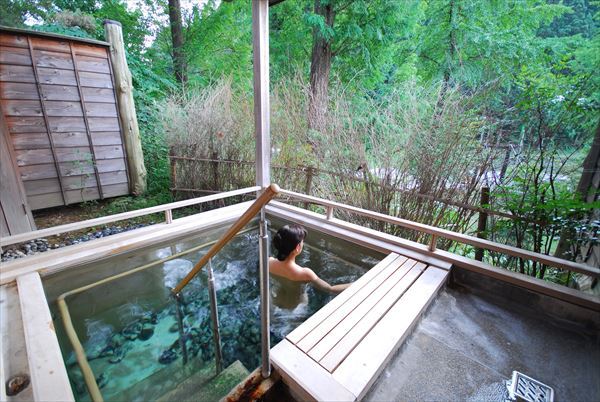
| Mountain Open-Air Bath “Fukayu” | Mountain Indoor Bath “Fukayu” |
|---|---|
 |
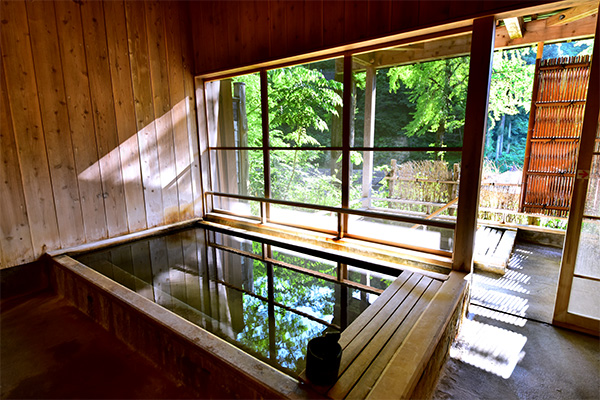 |
| True to its name, this bath reaches a maximum depth of 130 cm, making it exceptionally deep. The bottom of the bath is lined with stones, so guests bathe while standing. This unique design allows you to enjoy the hot spring while the stones gently stimulate the pressure points on the soles of your feet. | The indoor bath at “Fukayu” offers a calm and relaxing atmosphere. After enjoying the deep standing bath in the open-air section, it is the perfect place to unwind and soak at a leisurely pace. The bath features a wooden rim and a stone-lined tub, creating a warm, traditional ambiance. |
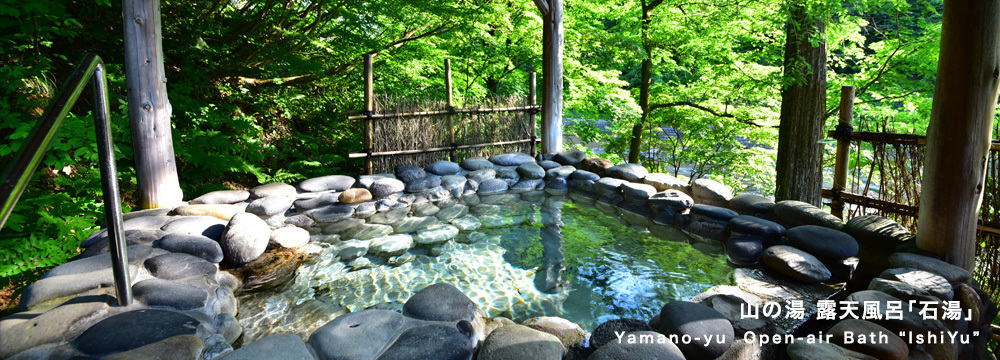
| Mountain Open-Air Bath “Ishiyu” | Large Public Baths “Maki-no-Yu” |
 |
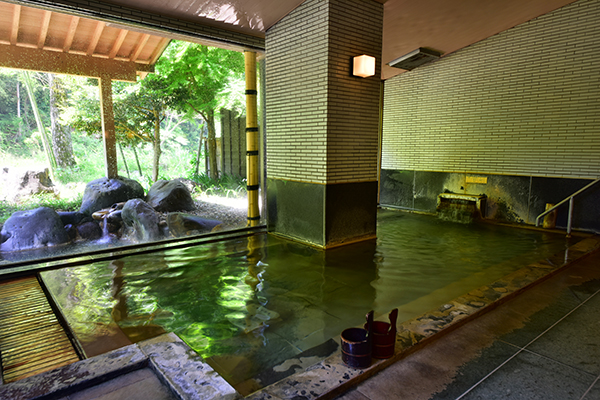 |
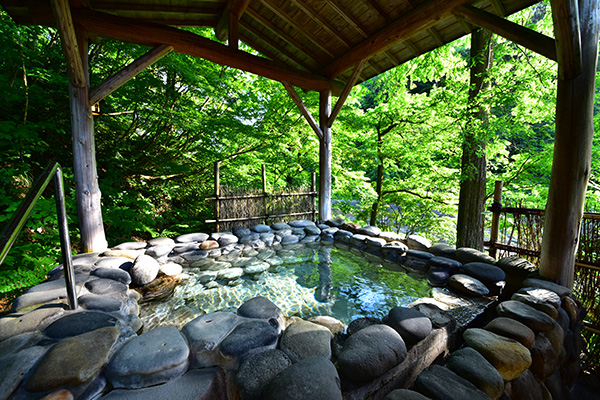
| Rankeisou offers two private open-air baths: “Fukayu” and “Ishiyu”. True to its name, “Ishiyu” features a stone-built bath surrounded by lush greenery, creating a rustic atmosphere where guests can fully immerse themselves in nature. | The “Maki-no-Yu” public bath features both an indoor bath and an open-air bath, each provided separately for men and women. The abundant mineral deposits visible around the baths reflect the rich mineral content of Rankeisou's spring water. Incidentally, “Maki” is a local place name that refers to the uppermost area of this region. |
Facility Report
Nestled in the mountains of Nagano, Sanjo city, in the Chuetsu region in Niigata Prefecture, near the border with Fukushima, “Rankeisou” is the only ryokan in the hot spring area known as Echigo-Nagano Onsen.
No wonder it has such a timeless appearance. It was originally built as a ryokan in front of Tsubame Station during the early Showa period (the late 1920s to early 1930s), the building was relocated to its current location around 1955. Today, it serves as “Ryokufuukan”, the main building and reception area of Rankeisou.
This three-story wooden building has a timeless presence, quietly preserving the stories of the many people who have been connected to it throughout the years. It exudes a quiet dignity. In 2012, Ryokufuukan was designated a Registered Tangible Cultural Property of Japan, in recognition of its historical and architectural value.
Rankeisou has long been renowned for its exceptional therapeutic hot spring, once celebrated as a “medicinal spring”.
The term “medicinal spring” is used intentionally because, during the early Showa period, the hot spring water was actually sold at a pharmacy in Tokyo's Hatchobori district as a remedy for burns.
The spring water contains an extraordinarily high concentration of salt. This unusually high salinity was believed to provide bactericidal properties, making it highly valued for its healing effects.
The story of this private spring source began in the late Taisho period (around 1924–1926), when the founder, Yasukichi Otake, discovered the spring. Inspired by its remarkable qualities, he opened as a therapeutic bathing facility in 1927 (Showa 2), laying the foundation for what is now Rankeisou.
Today, Rankeisou offers a total of 16 guest rooms (as of 2026), spread across three distinctive buildings.
The first is “Ryokufuukan”, the main building and reception area, which has been designated as a Registered Tangible Cultural Property of Japan.
The second is “Keiryukan”, a guest room wing built in 1992.
The third is “Suiyukan”, a guest room wing with Western-style beds, renovated in November 2022. It was created by refurbishing “Rindokan”, a building originally constructed in the early 1960s and extensively renovated in 2001.
“Ryokufuukan” originally featured guest rooms without private bathrooms or toilets. Following renovations completed in 2025, two of the rooms were equipped with private toilets. With its warm wooden architecture and evokes the charm of traditional Japan, this building remains a favorite among returning guests. (5 rooms)
“Keiryukan” offers traditional Japanese-style rooms with private bathrooms and toilets, making it the main guest room wing of Rankeisou. Each room features a large picture window overlooking the scenic mountain valley and the Sumon River. (8 rooms)
The guest rooms in “Suiyukan” (formerly Rindokan) feature tatami flooring with Western-style beds, making them ideal for guests of all ages, from young children to seniors. The private open-air bath “Yama-no-Yu” is conveniently located right next to the building.
Each room is also equipped with a spacious desk suitable for remote work, as well as both Wi-Fi and wired LAN access. With its open terrace and work-friendly environment, “Suiyukan” is an excellent choice for guests planning an extended stay or a workation. (3 rooms)
The surrounding natural landscape invites guests to enjoy a leisurely stroll.
In summer, children can often be seen playing in the clear waters of the Sumon River, which flows right in front of the inn. This crystal-clear mountain stream is also home to iwana (Japanese char) and ayu (sweetfish), making it a popular spot for guests who enjoy fishing.
An outdoor table tennis area is also available, offering a refreshing way to relax and enjoy a bit of exercise while surrounded by the fresh mountain air.
Rankeisou offers something special in every season.
In spring, guests can enjoy the delicate beauty of Himesayuri lilies, wildflowers, and cherry blossoms. Soaking in the hot spring while surrounded by fresh greenery and the sound of snowmelt-fed streams is a truly luxurious experience.
Summer brings a magical atmosphere as fireflies dance above the irrigation canal beside the inn, where a traditional waterwheel slowly turns. The cool breeze from the mountain stream provides a welcome escape from the heat.
In autumn, the surrounding landscape is transformed by vibrant fall colors, creating breathtaking scenery in every direction.
Winter turns the area into a fantastical world of snow, characteristic of one of Japan's heaviest snowfall regions. Guests can enjoy a relaxing “yukimi-buro” (snow-viewing bath) while soaking in the hot spring. From February to mid-March, guests can also enjoy playing in traditional kamakura snow huts. Squirrels and Japanese giant flying squirrels are also frequently seen in the area.
The cuisine at Rankeisou changes with the seasons, featuring the freshest local ingredients, including wild mountain vegetables, freshwater fish, and vegetables harvested at their peak.
Prepared with fresh mountain spring water, these wholesome dishes showcase the rich bounty of the surrounding mountains and countryside, creating a memorable dining experience that has inspired many guests to return time and again.
Rankeisou reflects a philosophy of preserving its heritage while embracing modern comfort.
Nearby stands Yagigahana, a striking rock formation where peregrine falcons return each year to nest. In spring, visitors may even witness the parent birds raising their chicks.
For those leading busy lives in the city, knowing there is a secluded hot spring inn nestled in the heart of nature like this is enough to make you want to escape here whenever you need a break.
Travel Journal
Rates Data
| Room with two meals | From 24,200 yen |
|---|---|
| Room with breakfast | From 20,900 yen |
| Overnight stay without meals | From 19,800 yen |
| Single stay | - |
| Private bath fee for overnight stay | Free |
| Day-use bath | Adults: 1,000 yen / Children: 700 yen |
| Private day-use bath | Same rates as the Day-use bath |
Facility Data
| Founded in | 1927 (Showa 2) |
|---|---|
| Check in | 4:00 PM |
| Check out | 10:00 AM |
| Location of the ryokan | A secluded mountain inn nestled along the Sumon River, a clear mountain stream |
| Number of rooms | Total 16 rooms |
| Capacity | 60 people |
| Parking | 50 cars |
| Facilities | Gift Shop, Table Tennis, Garden with a Waterwheel |
| Internet | Wi-Fi available, Wired LAN available in the Suiyukan Annex |
| Handicapped-accessible rooms | Some supported |
| Toilet with shower | Equipped |
Transportation Access
| By Train | The nearest stations are Tsubame-Sanjo Station (approximately 2 hours from Tokyo Station by Joetsu Shinkansen) and Higashi-Sanjo Station (approximately 7 minutes from Tsubame-Sanjo Station via the JR Yahiko Line) |
|---|---|
| Shuttle Bus | Complimentary shuttle service is available to and from Tsubame-Sanjo Station and Higashi-Sanjo Station (reservation required) |
| By car | Approximately 23.4 km from the Sanjo-Tsubame Interchange (IC) on the Hokuriku Expressway via local roads |
| Address | Niigata/Echigo-Nagano Onsen/RANKEISOU 1450 Nagano, Sanjo City, Niigata 955-0132, JAPAN TEL:+81-(0)256-47-2211 |
- Data
- July 17, 2026