Ryokan Tanigawa
| Weak Alkaline Simple hot springs | pH |
|
| 弱アルカリ性単純温泉 | ||
| (Hypotonic, Weakly alkaline, High temperature spring) | ||
| 旧泉質名:単純温泉 | ||
Ideal for:
- People who want silky smooth skin
- People who prefer mild hot springs
- People with sleep difficulties
- People feeling stressed
- People recovering from injury or illness
- Address
- 524-1, Tanigawa, Minakami-cho, Tone-gun, Gunma 379-1619, JAPAN
- TEL
- +81-(0)278-72-2468

Official Website

Travel Journal
| Source | Status of Source Utilization | |
|---|---|---|
| Status of Source Emergence | (Self-Flowing from Drilled Well) |
Hot Spring Power Chart (5-point scale)
*Indoor bath in Large Public Bath
Hydrogen Ion Concentration (pH)

- Comment
- A gentle, leading “Hot springs for beautiful skin”, effective for mental fatigue and insomnia
Hot spring Specification
※This is an easy-to-understand expression based on the indications for each type of spring in the “Guidelines for the Mineral Spring Analysis Methods” revised in July 2014 by the Ministry of the Environment.
| ①Mental recovery | ②Insomnia | ③Promote blood circulation | ④Sensitivity to cold | ⑤Dry skin |
| ⑥Cuts | ⑦Skin diseases | ⑧Hypertension (mild) | ⑨Heartburn (drinking) | ⑩Gastrointestinal disorders (drinking) |
| ⑪Constipation (drinking) | ⑫Lifestyle-related disease | ⑬Diabetes | ⑭Gout | ⑮Countermeasures against metabolic syndrome |
| ⑯Biliary system anxiety (drinking) | ⑰Anaemia | ⑱Arthritis rheumatica | ⑲Spinal pain | ⑳Improved immunity |
| ㉑Muscle pain・Neuralgia | ㉒Mild asthma | ㉓Hemorrhoidal pain | ㉔Recovery from an illness | ㉕Recovery from fatigue |
- ※Note①・・・Indications for each spring include autonomic instability and depression.(Simple springs・Chloride springs・Carbon dioxide springs)
- ※Note③・・・Indications for each spring include peripheral circulatory failure(Chloride springs・Carbonate springs・Carbon dioxide springs・Hydrogen sulfide type sulphur spring)
- ※Note④・・・Indications for each spring include sensitivity to cold(Chloride springs・Carbonate springs・Sulfur springs・Carbon dioxide springs)and Iron containing springs
- ※Note⑦・・・Indications for each spring include xeroderma, atopic dermatitis, plaque psoriasis, epidermoid suppuration, chronic eczema(Chloride springs・Carbonate springs・Sulfate spring・Acidic springs・Sulfur springs)
- ※Note⑨・・・Indications for drinking each spring include reflux esophagitis(Carbonate springs)
- ※Note⑩・・・Indications for drinking each spring include atrophic gastritis, gastroduodenal ulcerations(Chloride springs・Carbonate springs)
- ※Note⑪・・・For drinking, Chloride springs and Sulfate spring
- ※Note⑫・・・Indications for each spring include hypercholesterolemia, diabetes, gout(for bathing, Acidic springs・Radioactive springs/for drinking, Carbonate springs・Iodine containing springs・Sulfur springs)
- ※Note⑮・・・Indications for drinking each spring include hypercholesterolemia(Sulfate spring・Iodine containing springs・Sulfur springs)
- ※Note⑱⑲・・・Indications for each spring include rheumatoid arthritis, ankylosing spondylitis(Radioactive springs)
- ※Note⑳・・・Radioactive springs
- ※Note㉑㉔・・・Simple Springs is suitable for rehabilitation due to its low irritation, and is also called “Hot springs for neuralgia” and “Hot springs for strokes”, although these are not listed as indications by spring quality.
| Applicable to indications by spring quality | Applicable to general indications |
7 Elements of Hot Springs for Beautiful Skin
Total 1 Points ※The number of points represents the quality of the “Hot springs for beautiful skin”.
| Skin cleansing effect | Anti-wrinkle and skin revitalizing effects | Skin whitening and spot prevention effects |
|---|---|---|
| Hydrogen carbonate springs | Sulfate springs | Sulfur springs |
| Skin smoothing effects | Skin coating and moisturizing effects | Dewy and moisturizing effects | Cleaning effects |
|---|---|---|---|
| (Weak) Alkaline springs | Chloride springs | Metasilicic acid (more than 100 mg/kg) | Metaboric acid (more than 10 mg/kg) |
- ※The “Four Best Beauty Springs” are said to be “Carbonate springs”, “Sulfate springs”, “Sulfur springs”, and “(Weak) Alkaline simple hot springs”.
- ※The “Chloride springs” coats the skin with a salt pack, keeping it warm and moisturized at the same time. It is also called “Hot spring for finishing touch” to be taken after the “Hot spring for beautiful skin” in which exfoliation has been removed.
- ※Hot springs containing 100 mg/kg or more of metasilicicic acid have an excellent moisturizing effect and is said to be “Hot spring for beautiful skin”.
- ※Hot springs containing 10 mg/kg or more of metaboric acid have a cleansing effect, is used in some eye drops, and is said to be effective in treating acne.
Water texture while bathing (5-point evaluation)
| Smooth |  |
|
|
|
 |
Velvety | |
|
|
|
|
|---|---|---|---|---|---|---|---|---|---|---|---|
| Satiny | |
|
|
|
|
Supple | |
|
|
|
|
| Fizzy | |
|
|
|
|
Tingling | |
|
|
|
|
 Indoor bath in Large Public Bath Indoor bath in Large Public Bath |
|||||||||||
Skin feeling after bathing (5-point evaluation)
| Silky | |
|
|
|
|
Tight | |
|
|
|
|
|---|---|---|---|---|---|---|---|---|---|---|---|
| Satiny | |
|
|
|
|
Tacky | |
|
|
|
|
| Dewy | |
|
|
|
|
Warming | |
|
|
|
|
| Indoor bath in Large Public Bath |
|||||||||||
View from the open-air bath (5-point evaluation)

 View View |
If the weather is good you can see Mt. Tanigawadake |
|---|
| Bath |
Private Open-air bath (Tanigawa-no-Yu) |
|---|
 |
|
|
Point 3 |
|---|
Hot Spring Source Usage
| Water added No |
Heated No |
Disinfected No |
Circulated No |
Bath additive No |
|---|---|---|---|---|
| ○ | ○/× | ○/× | ○/× | ○ |
| *100% free-flowing hot spring water: Large public baths for men and women, Open-air baths for men and women, Open-air baths in guest rooms *Free-flowing hot spring water + Circulation/Filtration combination: Private open-air baths |
||||
| Percentage of hot spring source |
100% | ||||
|---|---|---|---|---|---|
| Replacement frequency of hot spring water | Large public baths for men and women, Open-air baths for men and women, Private open air baths: Once a week Open-air bath in guest rooms: Once every 3 days |
||||
| Yield of hot spring water |
Four private sources with different temperatures are mixed and used / Source “Yakushi-no-Yu” (private source) is a natural gush, and the other three sources “Minegishi-no-Yu” and “Fujin-no-Yu” (both private sources) and “Fudo-no-Yu” (public source) are powered sources (sources that are drawn up by boring). | ||||
| Distance from the source to the bathtub |
Private source “Yakushi-no-Yu”, “Minegishi-no-Yu”, “Fujin-no-Yu” / Public source “Fudo-no-Yu” <Distance from the above-mentioned mixing tank to each hot water bathtub> Large Public Bath - approx. 370m, Private Open-air Bath - approx. 370m, Guest Room Open-air Bath - approx. 370m |
||||
| How hot spring water is drawn | Drawn by pipe | ||||
| Temperature adjustment | |||||
| Drinking spring | Cannot | ||||
| “Gensen-Kakenagashi” Bath | Large Public Baths for men and women, Open-air Baths for men and women, Open-air Baths in guest rooms | ||||
Hot Spring Composition TableHot Spring Analysis Report
| Spring Quality | Weak Alkaline Simple hot springs (Hypotonic, Weakly alkaline, High temperature spring) 旧泉質名:単純温泉 |
|---|---|
| Color of hot spring | Clear and colorless |
| Scent of hot spring | Almost no odor |
| Dissolved substances | 667 mg/kg *Active components are about 4-6 times more than commercial bath additives!(Sum of components (1) + (2) + (3), excluding gaseous substances) |
| Temperature of spring | 48.3℃ (18℃ at the time of the survey) |
| pH | 8.3 (Weakly alkaline) |
| Yield | About 108 liters per minute Amount of hot spring use per person (yield / bath capacity):About 1.54 liters/person(maximum capacity of 70 people) |
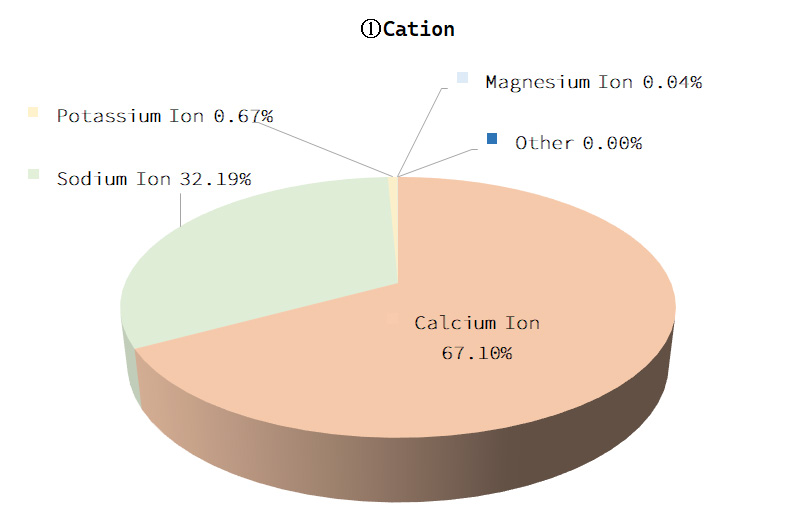
Hot Spring Composition (Amount contained in 1 kg of spring)
 |
|||
|---|---|---|---|
| ①Cation | mg | mval | mval% |
| Calcium Ion (Ca2+) | 125 | 6.24 | 67.10 |
| Sodium Ion (Na+) | 68.8 | 3.00 | 32.19 |
| Potassium Ion (K+) | 2.44 | 0.06 | 0.67 |
| Magnesium Ion (Mg2+) | 0.05 | 0.00 | 0.04 |
| Ferro Ion (Fe2+) | 0.04 | 0.00 | 0.00 |
| Manganese Ion (Mn2+) | 0.006 | 0.00 | 0.00 |
| Aluminum Ion (Al3+) | <0.05 | 0.00 | 0.00 |
| Cations Total(1) | 196 | 9.30 | 100.00 |
 |
|||
|---|---|---|---|
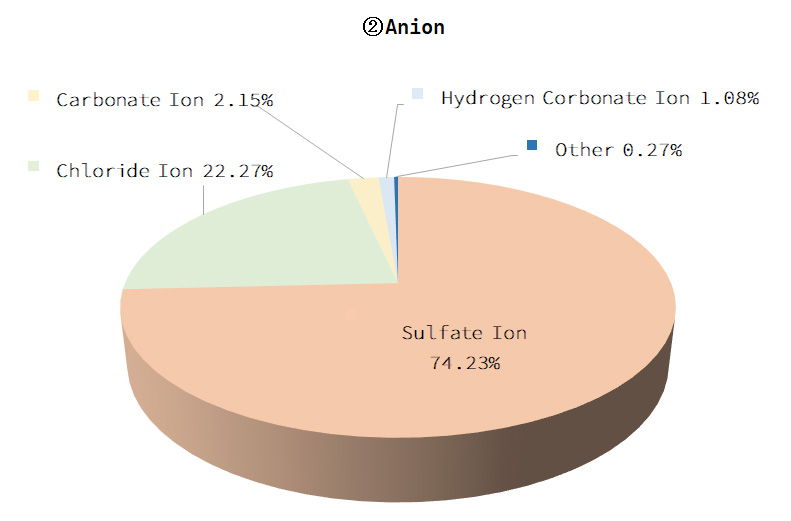
| ②Anion | mg | mval | mval% |
| Sulfate Ion (SO42-) | 332 | 6.90 | 74.23 |
| Chloride Ion (Cl-) | 73.4 | 2.07 | 22.27 |
| Carbonate Ion (CO32-) | 6.0 | 0.20 | 2.15 |
| Hydrogen Corbonate Ion (HCO3-) | 6.1 | 0.10 | 1.08 |
| Fluoride Ion (F-) | 0.5 | 0.03 | 0.27 |
| Anion Total(2) | 418 | 9.30 | 100.00 |
| ③Non-dissociated Components | mg | mmol | |
|---|---|---|---|
| Metasilicic Acid (H2SiO3) | 48.9 | 0.63 | |
| Metaboric Acid (HBO2) | 3.7 | 0.08 | |
| Non-dissociated Components Total(3) | 52.6 | 0.71 | |
| Dissolved Gas Components | mg | mmol | |
|---|---|---|---|
| Free carbon dioxide (CO2) | 0.00 | 0.00 | |
| Free hydrogen sulfide (H2S) | 0.00 | 0.00 | |
| Dissolved Gas Components Total(4) | 0.00 | 0.00 | |
| Other Trace Components | |||
|---|---|---|---|
| Copper Ion: 0.002mg/kg, Lead Ion: 0.005mg/kg, Total Arsenic: 0.079mg/kg, Total Mercury: 0.0005mg/kg |
★are the components related to the “spring quality” and the components that qualify conditions for “Hot spring” and “Therapeutic hot spring”.
Indications by Spring Quality for Bathing (Revised on July 1, 2014)
Autonomic instability, Insomnia, Depression
General Indications for Bathing (Revised on July 1, 2014)
Chronic pains or stiffness of muscles or joints (chronic phase of rheumatoid arthritis, osteoarthritis, lower back pain, nerve pains, frozen shoulder, bruises, sprains, etc.),
Muscle stiffness by motor paralysis, Sensitivity to cold, Peripheral circulatory disturbance,
Gastrointestinal hypofunction (slow digestion, intestinal gas formation, etc.),
Mild hypertension, Impaired glucose tolerance (diabetes), Mild hypercholesterolemia,
Mild asthma or Emphysema, Hemorrhoidal pains, Autonomic instability,
Various symptoms from stress (sleep disorders, depression, etc.),
Restorative phase from illness, Recovery from fatigue, Health promotion
Contraindications by Spring Quality for Bathing (Revised on July 1, 2014)
None
General Contraindications for Bathing (Revised on July 1, 2014)
Active stage of diseases (especially when fever is accompanied), Active tuberculosis,
Advanced malignant tumor, or the case of significant debility involving severe anemia,
Severe cardiac or lung diseases involving suffocation feelings with a little movement,
Severe kidney disease involving edema, Gastrointestinal bleeding,
When bleeding is visible, Acute exacerbation stage of chronic diseases, etc.
Indications by Spring Quality for Drinking
*Not drinkable
Date of Analysis (The above hot spring composition table is cited from the survey data of the following institution)
April 30, 2013 (Gunma Pharmaceutical Association, Environmental Health Testing Center)
- *Indications and contraindications for hot springs are in accordance with “Guidelines for the Mineral Spring Analysis Methods” revised on July 1, 2014.
- *Data was provided by the inn.
20 qualifications for “Hot spring” and 8 qualifications for “Therapeutic hot spring”
| Conditions/Components (contained amount in 1kg) ※If even one of the conditions is cleared, it is a “Hot spring” or “Therapeutic hot spring” |
A【Hot Springs Act】 Conditions of the “Hot spring” |
B【The Guideline for analysis of Kosen】 Conditions of the “Therapeutic hot spring” |
|
|---|---|---|---|
| 1 | Temperature (when collected from source) | 25℃ or higher | |
| 2 | Dissolved substances (excluding gaseous) | Total amount 1,000 mg or more | |
| 3 | Free carbon dioxide (CO2) | 250 mg or more | 1000 mg or more(Carbon dioxide springs) |
| 4 | Lithium Ion (Li+) | 1 mg or more | ― |
| 5 | Strontium Ion (Sr2+) | 10 mg or more | ― |
| 6 | Barium Ion (Ba2+) | 5 mg or more | ― |
| 7 | Total Iron Ion[Fe2+(Iron(Ⅱ) Ferro ion)+Fe3+(Iron(Ⅲ) Ferri ion)] | 10 mg or more | 20 mg or more(Iron containing springs) |
| 8 | First Manganese Ion (Mn2+) | 10 mg or more | ― |
| 9 | Hydrogen Ion (H+) | 1 mg or more | 1 mg or more (Acidic springs) |
| 10 | Bromine Ion (Br-) | 5 mg or more | ― |
| 11 | Iodide Ion (I-) | 1 mg or more | 10 mg or more (Iodine containing springs) |
| 12 | Fluoride Ion (F-) | 2 mg or more | ― |
| 13 | Hydro Arsenate Ion (HAsO42-) | 1.3 mg or more | ― |
| 14 | Meta-arsenic Acid (HAsO2) | 1 mg or more | ― |
| 15 | Total sulfur (S) [HS-(Hydrogen sulfide ion)+S2O32-(Thiosulfate Ion)+H2S(Free hydrogen sulfide)] | 1 mg or more | 2 mg or more (Sulfur springs) |
| 16 | Metaboric acid (HBO2) | 5 mg or more | ― |
| 17 | Metasilicic acid (H2SiO3) | 50 mg or more | |
| 18 | Bicarbonate soda (NaHCO3) | 340 mg or more | ― |
| 19 | Radon (Rn) | 20 or more (unit: ten ppb curie) 20×10-10Ci(curie) or more 20 or more(ten ppb curie) =74Bq(becquerel) / 5.5mache or more |
30 nanocurie or more (Radioactive springs) 30×10-10Ci(curie) or more 30 or more(ten ppb curie) =111Bq(becquerel) / 8.25 macheor more |
| 20 | Radium salt (as Ra) | 10-8mg or more 1/100 million mg or more |
― |
| Number of conditions cleared this “Hot spring” or “Therapeutic hot spring” is: | 1 (out of 20) | 1 (out of 8) | |
| Total 2 Points | |||
Hot Spring Legends and More
Traditionally documented efficacies
-
Historical figures who bathed in this hot spring
Osamu Dazai
Celebrities who bathed in this hot spring
-
Hot Spring (Onsen) Report
The name of the spring quality is “Weak Alkaline Simple hot springs” with a pH of 8.3. It is said to be a typical “Hot springs for beautiful skin”. Because it removes dead skin cells and makes the skin feel smooth and silky after bathing.
Simple hot spring is a type of hot spring with less dissolved substances, which means that it is low irritating, so there is no risk of getting a hot spring fatigue unless you take a very long bath. It is also said to be “Hot springs for family” because it is gentle to children and the elderly, as well as to those with sensitive skin. Because of the quality of the spring, it is also suitable for rehabilitation after illness or surgery, and is also known as “Hot springs for neuralgia” or “Hot springs for stroke (palsy)”. Even though the dissolved substances are relatively less, it should be added that this hot spring has about 4 to 6 times more active components than commercially available bath additives. Furthermore, looking more deeply at the Hot Spring Analysis Report, the calcium ions, which are said to help stabilize the mind, were noticeable. Also, sodium and chloride ions are abundant, indicating that this is a well-warming spring.
In general, hot springs can be expected to be effective when bathed in them, known as indications.
Chronic pains or stiffness of muscles or joints (chronic phase of rheumatoid arthritis, osteoarthritis, lower back pains, nerve pains, frozen shoulder, bruises, sprains, etc.), Muscle stiffness in motor paralysis, Sensitivity to cold, Peripheral circulatory disturbance, Gastrointestinal hypofunction (slow digestion, intestinal gas formation, etc.), Mild hypertension, Impaired glucose tolerance (diabetes), Mild hypercholesterolemia, Mild asthma or Emphysema, Hemorrhoidal pains, Autonomic instability, Various symptoms from stress (sleep disorders, depression, etc.), Restorative phase from illness, Recovery from fatigue, Health promotions are the General indications for bathing.
In addition to this, there are indications by spring quality that can be expected to be even more effective depending on the type of hot spring.
The indications for Simple hot springs are Autonomic instability, Insomnia, Depression.
In other words, this spring is a so-called mental health spring. When the autonomic nervous system is out of balance, some people experience fatigue, headaches, nausea, excessive sweating, palpitations, irregular heartbeat, insomnia, dizziness, stiff shoulders, numbness in the hands and feet, and many other signs of illness. Bathing in a Simple hot spring means that the gentle spring water will low-irritation to the skin, increase relaxation, and relieve stress. In Japan, there are currently 10 different types of spring quality, but only Simple hot springs have “Insomnia” as an indication for each type of spring quality.
Ryokan Tanigawa has a total of 4 private and 1 public sources of spring water.
The 4 sources with different temperatures (58-44 °C) are mixed to the suitable temperature and delivered to the bathtubs.
Using those abundant hot spring sources, the men's and women's large public baths and open-air baths, as well as the open-air baths in guest rooms, are 100% natural free-flowing hot spring water, so new hot spring water is constantly being poured into the bathtubs (108 liters/minute) and the hot spring water overflows from the bathtubs.
The 2 private open-air baths are always filled with new hot spring water, but the hot spring water is recycled by using a circulation and filtration system to disinfect the water with chlorine and ozone. It may be difficult to control the temperature of the hot spring water.
Being away from daily life and experiencing fresh hot spring areas in this mountainous area rich in negative ions at the foot of the famous Mt. Tanigawadake is the right choice from a medical treatment perspective, and even healthy people can refresh themselves both mentally and physically. In other words, stimulating the five senses is recognized to have the effect of normalizing the functions of metabolism, immunity, and reproduction through hormones from the brain, one of the endocrine organs, as well as the autonomic nervous system, which controls blood pressure, respiration, and other functions. This is known as the “Environmental change effect”, one of the physical effects of hot springs, and is expected to have a psychological effect as well.
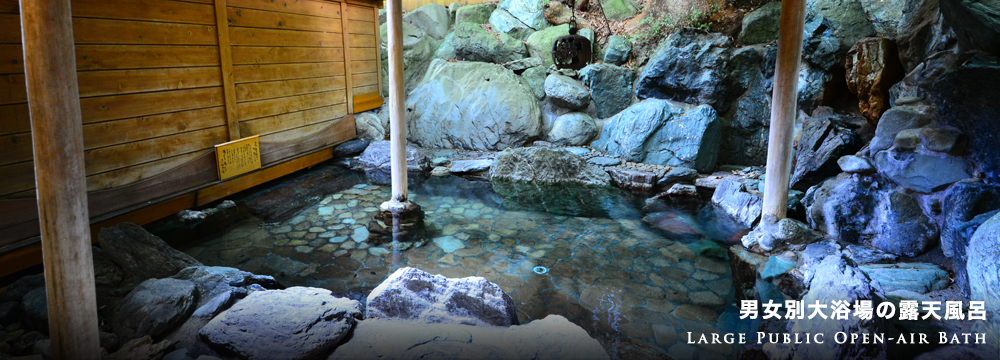
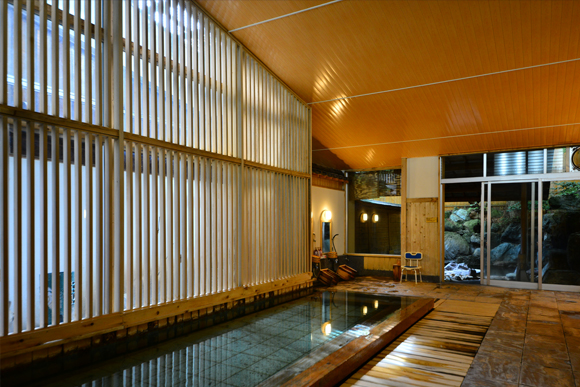
| Indoor bath in the Large public baths for men and women | Open-air bath in the Large public baths for men and women |
|---|---|
 |
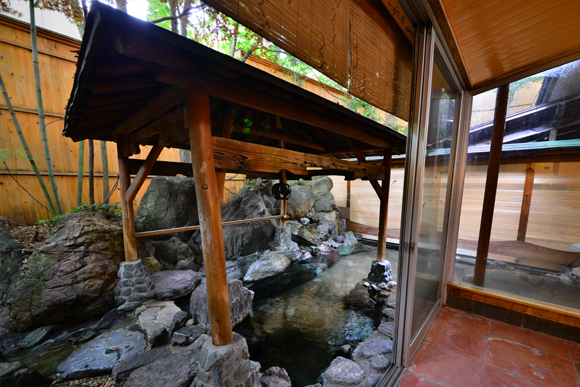 |
| A spacious indoor bath features 100% natural, free-flowing water drawn from four sources. Beyond it lies an open-air bath where you can enjoy the fresh air. The weakly alkaline simple hot spring water gently removes dead skin cells, leaving your skin smooth and silky. The baths alternate between men and women depending on the time of day. | Beyond the large public baths lie open-air baths featuring rustic tubs crafted from locally sourced Sanba Stone. In winter, guests can experience the magic of “yukimi” (snow-viewing) surrounded by a blanket of snow. The indoor and outdoor baths, which differ slightly in design, alternate between men and women depending on the time of day. |
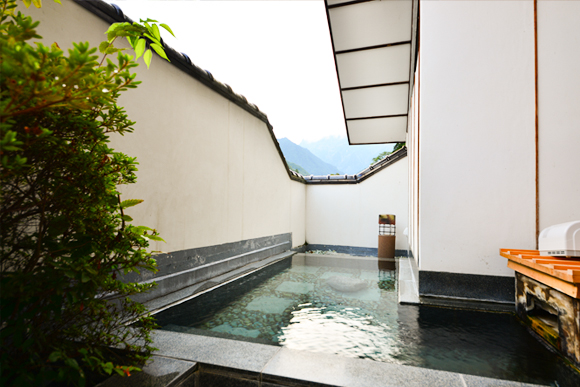
| Private Open-air bath “Tanigawa-no-Yu” | Guest room Open-air bath in Room 625 |
 |
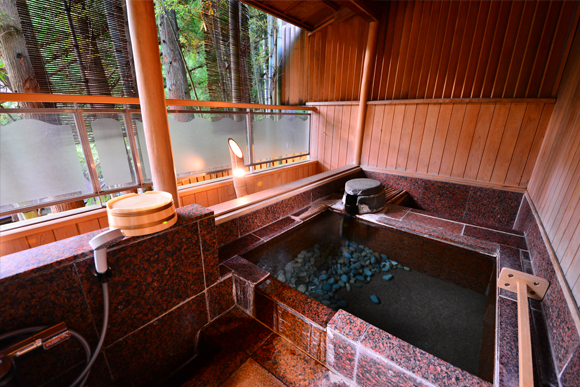 |
| One of the two private open-air baths at the inn, “Tanigawa-no-Yu”, offers a view of Mt. Tanigawadake when the weather is clear. By reserving at the front desk, guests can enjoy Japanese sake served in a traditional masu (wooden cup) along with ice cream, all while soaking in the bath. | There are three popular guest rooms with private open-air baths. Each room features a bath filled with 100% natural free-flowing hot spring water, renowned for its skin-beautifying properties. Smooth round stones lining the bottom of the tub provide a gentle, soothing sensation. Guests can enjoy the luxury of experiencing the “Hot springs for beautiful skin” at any time they wish. |
Facility Report
Tanigawa Onsen is located in the northwestern part of Gunma Prefecture on the border of Niigata Prefecture, just below the southern side of Mt. Tanigawadake (1,977 m above sea level), which is one of the “100 most famous mountains in Japan”. Located in a forest rich in nature, the inns are lined up along the Tanigawa River's clear stream.
This hot spring area, which is one with nature, with its riverside open-air baths, murmuring mountain streams, and the sometimes chirping of kajika frogs, has been loved by many writers and artists, as evidenced by the stone monument to Osamu Dazai and the poem monument to Makisui Wakayama.
Tanigawa Onsen is one of the so-called Mizukami Onsenkyo (hot spring resorts), but it has been welcoming many guests from a different vector from the central part of Mizukami Onsen, where large onsen ryokan and hotels are in full swing. Although it is a small hot spring area with only 4 ryokan inns and a few pensions and guest houses, it is currently the most popular hot spring area in Mizukami Onsenkyo.
Ryokan Tanigawa is a hot spring inn with 28 guest rooms. In the lobby, a photo gallery of Mt. Tanigawadake is permanently displayed, and seasonal exhibition events are held. The large public baths for men and women are equipped with an open-air bath, also 2 private open-air baths are available.
Ryokan Tanigawa offers a wide variety of guest rooms, including standard Japanese-style rooms, rooms with free-flowing hot spring open-air baths, and rooms with beds on tatami matted flooring in the Japanese-style rooms. Recently, there are rooms with king-sized beds where you can enjoy watching movies with a projector on the wall, and also active-type rooms that you can store your own skis, snowboards, and mountain bikes, etc. in the room.
The secret of this popularity is the meticulous service and ideas.
For example, the inn has provided numerous services, such as special hinoki squares filled with local sake and ice cream delivered to the open-air bath, socks washing service, and maitake mushroom miso soup served in the lobby before breakfast, etc. The cuisine, using local ingredients, is also well-received, and the inn is a favorite among repeat guests.
It is also known as the inn related to novelist Osamu Dazai (1909-1948), who wrote “Run Melos!”, “The setting sun”, and “No longer human”, etc. In 1936, at the recommendation of literary giant Yasunari Kawabata (1899-1972), he stayed at this inn (called Kawakuboya at that time) for about one month to recover from an illness (so called “environmental change therapy”). The “Osamu Dazai Mini Gallery” inside the inn exhibits valuable relics and books.
Activities in the area around the inn are also popular. From spring through fall, rafting and canyoning on the abundant Tone River are popular.
In winter, there seem to be a variety of options for skiing, snowboarding, and of course, taking a walk in the snowy landscape using snowshoes.
Soak to your heart's content in the “Hot spring for beautiful skin” and enjoy the delicious mountain air and spectacular scenery.
By the way, there is a luxury ryokan called “Bettei Senjuan” in this hot spring area. This inn, which is now well known by many people, including overseas visitors, as an admired inn with an open-air bath in every room, is also managed by “Ryokan Tanigawa”.
Travel Journal
Rates Data
| 1 night/2 meals fee | From 22,700 yen (tax included) |
|---|---|
| Private bath fee when overnight stay |
2,500 yen per group (tax included) |
| Day-trip bathing fee | 1,500 yen per adult (tax included) *Towel 500 yen (sale), 200 yen (rental), Bath towel 500 yen (rental) *No child fee |
| Private bath for day-stay |
Not allowed |
Facility Data
| Establishment | Established in 1981 |
|---|---|
| Check-In | 2:00 p.m. |
| Check-Out | 10:00 a.m. *11:00 a.m. depending on the plan |
| Number of Rooms | All 28 rooms (Japanese-style room 16/Japanese-Western style room 12) *Japanese-Western style rooms have beds on tatami mats. |
| Number of People Accommodated |
70 persons |
| Parking Area | Available for 50 cars |
| Facilities | Shop, Lounge, Footbath, Walking bath, Relaxation room (with fitness machines), Osamu Dazai Mini Gallery, Mt. Tanigawadake Photo Gallery, Exhibition space |
| Internet | Wi-Fi available *Around guest rooms and lounge |
| Barrier Free | Supported |
| Toilet with washer | Equipped |
Transportation Access
| By train | JR Joetsu Shinkansen, Jomo Kogen Station (about 75 min. from Tokyo Station) → Relay bus (about 25 min.) → JR Mizukami Station About 10 min. by car from JR Joetsu Line, Mizukami Station (*Pick-up service is available from Mizukami Station) |
|---|---|
| By car | About 10 min. by car from the Mizukami IC on the Kanetsu Expressway |
| Address | Gunma / Tanigawa Onsen/ Ryokan Tanigawa 524-1, Tanigawa, Minakami-cho, Tone-gun, Gunma 379-1619, JAPAN TEL:+81-(0)278-72-2468 |
- Data
- Jan. 23, 2026