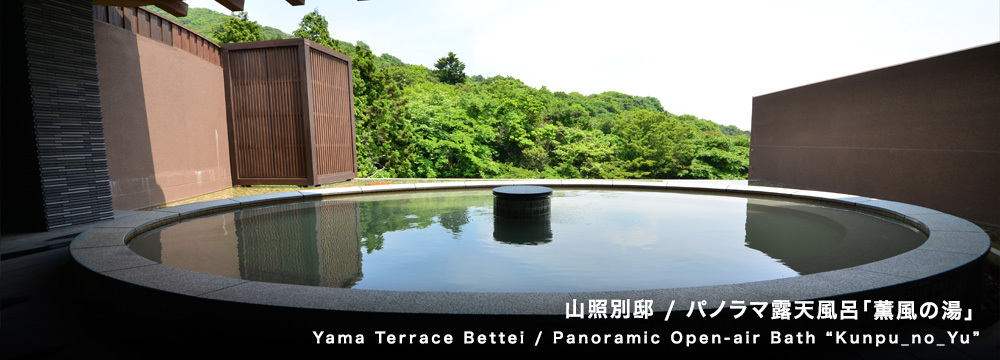
Unzen Fukudaya / Yama Terrace Bettei
| Acidic, Sulfur containing, Iron (Ⅱ,Ⅲ) ― Calcium ― Sulfate Springs (Hydrogen sulfide type) | pH |
|
| 酸性・含硫黄・鉄(Ⅱ ,Ⅲ ) ― カルシウム ― 硫酸塩泉(硫化水素型) | ||
| (Hypotonic, Acidic, High temperature spring) | ||
| 旧泉質名:酸性石膏硫化水素泉 | ||
Ideal for:
- People with skin conditions (e.g., atopic dermatitis)
- People with minor cuts
- People seeking skin‑beautifying effects
- People concerned about dark spots
- People seeking firmer, more radiant skin
- People with dry skin
- People sensitive to cold
- People looking to relax and relieve stress
- Address
- 380-2 Unzen, Obama-cho, Unzen city, Nagasaki 854-0621, JAPAN
- TEL
- +81-(0)957-73-2151

Official Website

Travel Journal
| Source | Status of Source Utilization | |
|---|---|---|
| Status of Source Emergence |
Hot Spring Power Chart (5-point scale)
Hydrogen Ion Concentration (pH)

- Comment
- Hot spring water with a slight tangy sensation and high antibacterial effect
Hot spring Specification
※This is an easy-to-understand expression based on the indications for each type of spring in the “Guidelines for the Mineral Spring Analysis Methods” revised in July 2014 by the Ministry of the Environment.
| ①Mental recovery | ②Insomnia | ③Promote blood circulation | ④Sensitivity to cold | ⑤Dry skin |
| ⑥Cuts | ⑦Skin diseases | ⑧Hypertension (mild) | ⑨Heartburn (drinking) | ⑩Gastrointestinal disorders (drinking) |
| ⑪Constipation (drinking) | ⑫Lifestyle-related disease | ⑬Diabetes | ⑭Gout | ⑮Countermeasures against metabolic syndrome |
| ⑯Biliary system anxiety (drinking) | ⑰Anaemia | ⑱Arthritis rheumatica | ⑲Spinal pain | ⑳Improved immunity |
| ㉑Muscle pain・Neuralgia | ㉒Mild asthma | ㉓Hemorrhoidal pain | ㉔Recovery from an illness | ㉕Recovery from fatigue |
- ※Note①・・・Indications for each spring include autonomic instability and depression.(Simple springs・Chloride springs・Carbon dioxide springs)
- ※Note③・・・Indications for each spring include peripheral circulatory failure(Chloride springs・Carbonate springs・Carbon dioxide springs・Hydrogen sulfide type sulphur spring)
- ※Note④・・・Indications for each spring include sensitivity to cold(Chloride springs・Carbonate springs・Sulfur springs・Carbon dioxide springs)and Iron containing springs
- ※Note⑦・・・Indications for each spring include xeroderma, atopic dermatitis, plaque psoriasis, epidermoid suppuration, chronic eczema(Chloride springs・Carbonate springs・Sulfate spring・Acidic springs・Sulfur springs)
- ※Note⑨・・・Indications for drinking each spring include reflux esophagitis(Carbonate springs)
- ※Note⑩・・・Indications for drinking each spring include atrophic gastritis, gastroduodenal ulcerations(Chloride springs・Carbonate springs)
- ※Note⑪・・・For drinking, Chloride springs and Sulfate spring
- ※Note⑫・・・Indications for each spring include hypercholesterolemia, diabetes, gout(for bathing, Acidic springs・Radioactive springs/for drinking, Carbonate springs・Iodine containing springs・Sulfur springs)
- ※Note⑮・・・Indications for drinking each spring include hypercholesterolemia(Sulfate spring・Iodine containing springs・Sulfur springs)
- ※Note⑱⑲・・・Indications for each spring include rheumatoid arthritis, ankylosing spondylitis(Radioactive springs)
- ※Note⑳・・・Radioactive springs
- ※Note㉑㉔・・・Simple hot spring water is suitable for rehabilitation due to its low level of stimulation, and although it is not listed as an indication by spring quality, it is also called "Hot spring for neuralgia" and "Hot spring for stroke".
| Applicable to indications by spring quality | Applicable to general indications |
7 Elements of Hot Springs for Beautiful Skin
Total3Points ※The number of points represents the quality of the “Hot springs for beautiful skin”.
| Skin cleansing effects | Anti-wrinkle and skin revitalizing effects | Skin whitening and spot prevention effects |
|---|---|---|
| Hydrogen carbonate springs | Sulfate springs | Sulfur springs |
| Skin smoothing effects | Skin coating and moisturizing effects | Dewy and moisturizing effects | Cleaning effects |
|---|---|---|---|
| (Weak) Alkaline springs | Chloride springs | Metasilicic acid (more than 100 mg/kg) | Metaboric acid (more than 10 mg/kg) |
- ※The “Four Best Beauty Springs” are said to be “Carbonate springs”, “Sulfate springs”, “Sulfur springs”, and “(Weak) Alkaline simple hot springs”.
- ※The “Chloride springs” coats the skin with a salt pack, keeping it warm and moisturized at the same time. It is also called “Hot spring for finishing touch” to be taken after the “Hot spring for beautiful skin” in which exfoliation has been removed.
- ※Hot springs containing 100 mg/kg or more of metasilicicic acid have an excellent moisturizing effect and is said to be “Hot spring for beautiful skin”.
- ※Hot springs containing 10 mg/kg or more of metaboric acid have a cleansing effect, is used in some eye drops, and is said to be effective in treating acne.
Water texture while bathing (5-point evaluation)
| Smooth |  |
 |
|
|
|
Velvety | |
|
|
|
|
|---|---|---|---|---|---|---|---|---|---|---|---|
| Satiny | |
|
|
|
|
Supple | |
|
|
|
|
| Fizzy | |
|
|
|
|
Tingling | |
|
|
|
|
 Indoor bath of the Large Public Bath Indoor bath of the Large Public Bath |
|||||||||||
Skin feeling after bathing (5-point evaluation)

| Silky | |
|
|
|
|
Tight | |
|
|
|
|
|---|---|---|---|---|---|---|---|---|---|---|---|
| Satiny | |
|
|
|
|
Tacky | |
|
|
|
|
| Dewy | |
|
|
|
|
Warming | |
|
|
|
|
| Indoor bath of the Large Public Bath |
|||||||||||
View from the open-air bath (5-point evaluation)

 View View |
Open view overlooking the forest and town of Unzen Onsen |
|---|
| Bath |
Yama Terrace Bettei / Panoramic open-air bath “Kunpu-no-Yu” |
|---|
 |
|
|
|
Point 4 |
|---|
Hot Spring Source Usage
| Water added No |
Heated No |
Disinfected No |
Circulated No |
Bath additive No |
|---|---|---|---|---|
| ○ | ○ | ○ | ○ | ○ |
| *All bathtubs are 100% natural free-flowing hot spring water | ||||
| Percentage of hot spring source |
100% | ||||
|---|---|---|---|---|---|
| Replacement frequency of hot spring water | Once a day | ||||
| Yield of hot spring water |
Two private springs (naturally gushing) with the same spring quality are mixed and used | ||||
| Distance from the source to the bathtub |
About 100m (the source gushes out on the site) | ||||
| How hot spring water is drawn | Drawn by a pipe | ||||
| How water temperature is adjusted | Adjust the volume of hot water | ||||
| Drinking spring | Cannot *Non-submission of application for drinking to the health department | ||||
| “Gensen-Kakenagashi” Bath | Open-air bath x 2, Indoor bath x 2, Guest room open-air bath x 9 (main building 2 + annex 7), Private half-open-air bath x 2, Private bath x 1 | ||||
Hot Spring Composition TableHot Spring Analysis Report
| Spring Quality | Acidic, Sulfur containing, Iron (Ⅱ,Ⅲ) ― Calcium ― Sulfate Springs (Hydrogen sulfide type)(Hypotonic, Acidic, High temperature spring) 旧泉質名:酸性石膏硫化水素泉 |
|---|---|
| Color of hot spring | Slight yellow and Cloudy white |
| Scent of hot spring | Hydrogen sulfide smell |
| Dissolved substances | 1028.5 mg/kg (Sum of components (1) + (2) + (3), excluding gaseous substances) |
| Temperature of spring | 52.0℃ |
| pH | 2.3 (Acidic) |
| Yield | About 240 liters per minute Amount of hot spring use per person (yield / bath capacity):About 2.4 liters/person(maximum capacity of 100 people) |
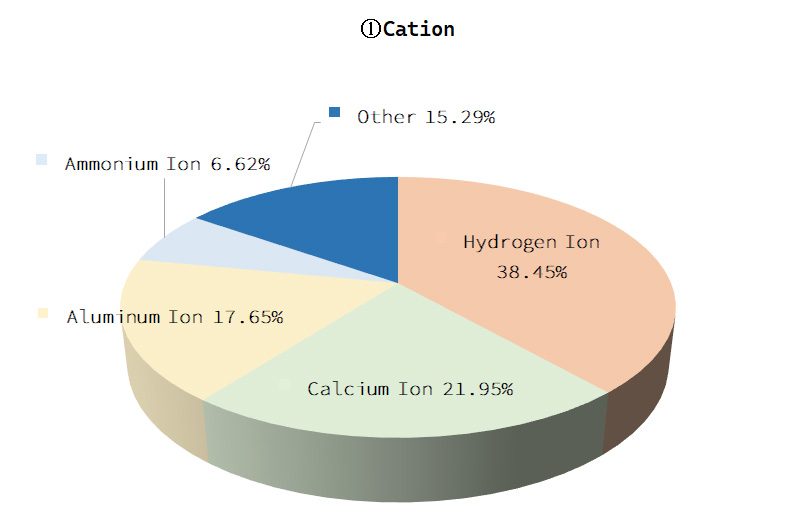
Hot Spring Composition (Amount contained in 1 kg of spring)
 |
|||
|---|---|---|---|
| ①Cation | mg | mval | mval% |
| Hydrogen Ion (H+)★ | 5.1 | 5.08 | 38.45 |
| Calcium Ion (Ca2+) | 58.1 | 2.90 | 21.95 |
| Aluminum Ion (Al3+) | 21.0 | 2.33 | 17.65 |
| Ammonium Ion (NH4+) | 15.8 | 0.88 | 6.62 |
| Iron(Ⅱ,Ⅲ) Ion (Fe2+,Fe3+)★ | 20.7 | 0.74 | 5.60 |
| Magnesium Ion (Mg2+) | 8.8 | 0.72 | 5.47 |
| Sodium Ion (Na+) | 10.4 | 0.45 | 3.42 |
| Potassium Ion (K+) | 3.6 | 0.09 | 0.70 |
| Manganese Ion (Mn2+) | 0.5 | 0.02 | 0.14 |
| Cations Total(1) | 144.0 | 13.21 | 100 |
 |
|||
|---|---|---|---|
| ②Anion | mg | mval | mval% |
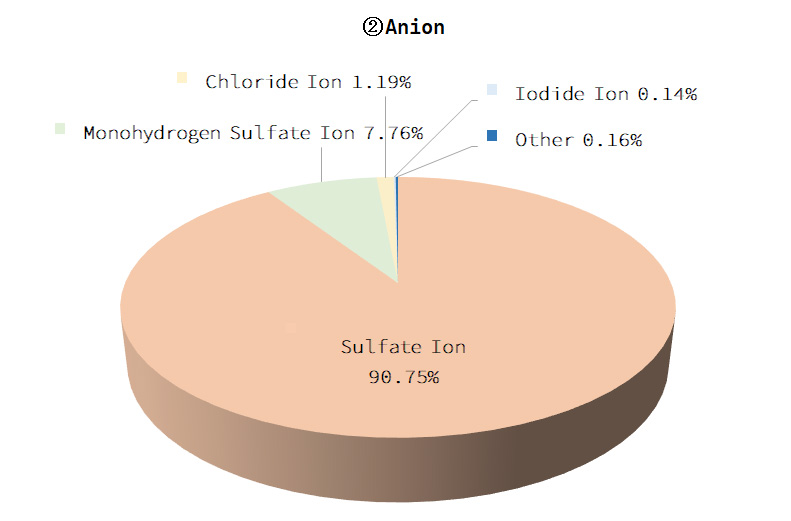
| Sulfate Ion (SO42-)★ | 590.2 | 12.29 | 90.75 |
| Monohydrogen Sulfate Ion (HSO4-) | 102.0 | 1.05 | 7.76 |
| Chloride Ion (Cl-) | 5.7 | 0.16 | 1.19 |
| Iodide Ion (I-)★ | 2.4 | 0.02 | 0.14 |
| Fluoride Ion (F-) | 0.2 | 0.01 | 0.08 |
| Thiosulfate Ion (S2O3-)★ | 0.3 | 0.01 | 0.04 |
| Dihydrogen Phosphate Ion (H2PO4-) | 0.5 | 0.01 | 0.04 |
| Anion Total(2) | 701.3 | 13.55 | 100.00 |
| ③Undissociated Components | mg | mmol | |
|---|---|---|---|
| Sulfuric Acid (H2SO4) | 1.3 | 0.01 | |
| Metasilicic Acid (H2SiO3)★ | 180.2 | 2.31 | |
| Metaboric Acid (HBO2) | 1.7 | 0.04 | |
| Undissociated Components Total(3) | 183.2 | 2.36 | |
| Dissolved Gas Components | mg | mmol | |
|---|---|---|---|
| Free carbon dioxide (CO2) | 101.1 | 2.30 | |
| Free hydrogen sulfide (H2S)★ | 7.3 | 0.21 | |
| Dissolved Gas Components Total(4) | 108.4 | 2.51 | |
| Other Trace Components | |||
|---|---|---|---|
| Total arsenic: less than 0.01 mg/kg, Lead: less than 0.01 mg/kg, Zinc: 0.09 mg/kg, Copper: less than 0.01 mg/kg, Total mercury: less than 0.0005 mg/kg |
★are the components related to the “spring quality” and the components that qualify conditions for “Hot spring” and “Therapeutic hot spring”.
Indications by Spring Quality for Bathing (Revised on July 1, 2014)
Atopic dermatitis, Plaque psoriasis, Impaired glucose tolerance (diabetes), Chronic eczema, Epidermal suppuration, Peripheral circulatory disturbance, Cuts, Sensitivity to cold, Depression, Dry skin
General Indications for Bathing (Revised on July 1, 2014)
Chronic pains or stiffness of muscles or joints (chronic phase of rheumatoid arthritis, osteoarthritis, lower back pain, nerve pains, frozen shoulder, bruises, sprains, etc.),
Muscle stiffness by motor paralysis, Sensitivity to cold, Peripheral circulatory disturbance,
Gastrointestinal hypofunction (slow digestion, intestinal gas formation, etc.),
Mild hypertension, Impaired glucose tolerance (diabetes), Mild hypercholesterolemia,
Mild asthma or Emphysema, Hemorrhoidal pains, Autonomic instability,
Various symptoms from stress (sleep disorders, depression, etc.),
Restorative phase from illness, Recovery from fatigue, Health promotion
Contraindications by Spring Quality for Bathing (Revised on July 1, 2014)
Hypersensitive skin or mucous membranes, dry skin in the elderly
General Contraindications for Bathing (Revised on July 1, 2014)
Active stage of diseases (especially when fever is accompanied), Active tuberculosis,
Advanced malignant tumor, or the case of significant debility involving severe anemia,
Severe cardiac or lung diseases involving suffocation feelings with a little movement,
Severe kidney disease involving edema, Gastrointestinal bleeding,
When bleeding is visible, Acute exacerbation stage of chronic diseases, etc.
Indications by Spring Quality for Drinking
Not drinkable
Date of Analysis (The above hot spring composition table is cited from the survey data of the following institution)
July 31, 2019 (Sankei Technos Corporation)
- *Indications and contraindications for hot springs are in accordance with “Guidelines for the Mineral Spring Analysis Methods” revised on July 1, 2014.
- *Data was provided by the inn.
20 qualifications for “Hot spring” and 8 qualifications for “Therapeutic hot spring”
| Conditions/Components (contained amount in 1kg) *If even one of the conditions is cleared, it is a “Hot spring” or “Therapeutic hot spring” |
A【Hot Springs Act】 Conditions of the “Hot spring” |
B【The Guideline for analysis of Kosen】 Conditions of the “Therapeutic hot spring” |
|
|---|---|---|---|
| 1 | Temperature (when collected from source) | 25℃ or more | |
| 2 | Dissolved substances (excluding gaseous) | Total amount 1,000 mg or more | |
| 3 | Free carbon dioxide (CO2) | 250 mg or more | 1000 mg or more(Carbon dioxide springs) |
| 4 | Lithium Ion (Li+) | 1 mg or more | ― |
| 5 | Strontium Ion (Sr2+) | 10 mg or more | ― |
| 6 | Barium Ion (Ba2+) | 5 mg or more | ― |
| 7 | Total Iron Ion[Fe2+(Iron(Ⅱ) Ferro ion)+Fe3+(Iron(Ⅲ) Ferri ion)] | 10 mg or more | 20 mg or more (Iron containing springs) |
| 8 | First Manganese Ion (Mn2+) | 10 mg or more | ― |
| 9 | Hydrogen Ion (H+) | 1 mg or more | 1 mg or more (Acidic springs) |
| 10 | Bromine Ion (Br-) | 5 mg or more | ― |
| 11 | Iodide Ion (I-) | 1 mg or more | 10 mg or more (Iodine containing springs) |
| 12 | Fluoride Ion (F-) | 2 mg or more | ― |
| 13 | Hydro Arsenate Ion (HAsO42-) | 1.3 mg or more | ― |
| 14 | Meta Arsenite (HAsO2) | 1 mg or more | ― |
| 15 | Total sulfur (S) [HS-(Hydrogen sulfide ion)+S2O32-(Thiosulfate Ion)+H2S(Free hydrogen sulfide)] | 1 mg or more | 2 mg or more (Sulfur springs) |
| 16 | Metaboric acid (HBO2) | 5 mg or more | ― |
| 17 | Metasilicic acid (H2SiO3) | 50 mg or more | ― |
| 18 | Bicarbonate soda (NaHCO3) | 340 mg or more | ― |
| 19 | Radon (Rn) | 20 or more (unit: ten ppb curie) 20×10-10Ci(curie)or more 20 or more(ten ppb curie) =74Bq(becquerel)/5.5mache or more |
30 nanocurie or more(Radioactive springs) 30×10-10Ci(curie)or more 30 or more(ten ppb curie) =111Bq(becquerel)/8.25 macheor more |
| 20 | Radium salt (as Ra) | 10-8mg or more 1/100 million mg or more |
― |
| Number of conditions cleared this “Hot spring” or “Therapeutic hot spring” is: | 7 (out of 20) | 5 (out of 8) | |
| Total 12 Points *Highest class number! | |||
Hot Spring Legends and More
Traditionally documented efficacies
Fatigue from hard work (in the old days, not only the peddlers who climbed the mountain road to Unzen, but also their horses, would be revitalized by this hot spring and head home).
Historical figures who bathed in this hot spring
Yoshida Shoin (1830-1859), Japanese intellectual
Celebrities who bathed in this hot spring
Numerous cultural and celebrity visitors, not mentioned due to private use
Hot Spring (Onsen) Report
Hot spring at “Unzen Fukudaya” is a private source and gushes naturally from the site. Naturally gushing means that the hot spring water is gushing to the surface of the ground without the need for mechanical power pumping. Although there are many source wells in Japan, only a few of them are naturally gushing hot springs. This means that the source is located close to the surface of the earth, which reduces the possibility of impurities mixing with the water.
Going back in time, until the early Showa period when cars became the common mode of transportation, food ingredients used at inns were transported by peddlers who came and went on horseback along the steep mountain paths in Unzen. It is said that it was this hot spring that relieved them of the fatigue caused by their hard work. A soak in the hot spring at this inn is said to have restored their energy and vitality.
Also, it is noteworthy that the location of the gush is on the site. The fact that the spring is gushing on the site means the distance from the source to the bathtub is close. However, as will be explained later, this source is a hot spring in which gases are dissolved, and such hot springs tend to oxidize quickly when exposed to the atmosphere. Thus, it is a pleasure to be able to enjoy the freshness of the spring water as it gushes out.
All baths (indoor baths, open-air baths, private baths, and guest room open-air baths) at this inn use 100% natural free-flowing hot spring water.
Free-flowing hot spring water means that after the water is poured into the baths, the overflowing water flows directly down the drain and is disposed of. Although this is an extravagant use of hot spring water, it is also the most efficient system to utilize the natural power of the hot spring water. The temperature of the water is also controlled by the amount of hot spring water poured into the bathtub, so you can experience 100% natural free-flowing hot spring water with no added water.
The spring quality is “Acidic, Sulfur containing, Iron (Ⅱ,Ⅲ) ― Calcium ― Sulfate Springs (Hydrogen sulfide type)”.
It is a bit long, but it is proof of the large number of components contained in the spring. Currently, Japan classifies springs into 10 types, but this inn's spring has 4 types: “Acidic springs”, “Sulfur springs”, “Iron containing springs”, and “Sulfate springs”.
First, “Acidic springs” must contain more than 1 mg/kg of hydrogen ions, and the hot spring at this inn contains a surprising 5.1 mg/kg of hydrogen ions. The “Acidic springs” has a very high antibacterial effect, and is said to be “Hot springs for skin diseases” because it widely removes the causes of skin surface problems. It is good for Plaque psoriasis, Impaired glucose tolerance (diabetes), and Epidermal suppuration. Also, it is good for trichophytia, trichomonas vaginitis, scabies, etc.
It is especially recommended for people with Atopic dermatitis.
Atopic dermatitis is caused by the presence of Staphylococcus aureus in the inflamed area, and the “Acidic springs” inhibit the growth of this bacterium.
Next is the “Sulfur springs”, which must contain at least 2 mg/kg of total sulfur (hydrogen sulfide ions + thiosulfate ions + free hydrogen sulfide). Here, free hydrogen sulfide is the main component, so the sulfur spring is also called a “Hydrogen sulfide type” spring. pH is Acidic, and the color of the water is usually a milky white.
The “Sulfur springs” have a wide range of features, and are representative of “Hot springs for beautiful skin” as well. It breaks down melanin in the dead skin layer, helps prevent spots, and can also be expected to have a whitening effect.
Like “Acidic springs”, it is said to be good for Atopic dermatitis, Plaque psoriasis, and Epidermal suppuration, as well as Chronic eczema.
Furthermore, hydrogen sulfide type sulfur springs are said to be good for Arteriosclerosis and Hypertension because they dilate peripheral capillaries. This is why it is called “Hot springs for lifestyle-related diseases”.
Hydrogen sulfide gas in hot springs can be dangerous in poorly ventilated bathhouses, but they are also sometimes referred to as “Hot springs for phlegm”, because it helps to relieve asthma and improve the clearing of phlegm.
One thing to keep in mind is that metal items such as rings and necklaces must be removed when bathing, as they can be discolored by the sulfuric components.
The 3rd “Iron containing springs” is a hot spring that must contain more than 20 mg of total iron ions (Fe Ⅱ + Fe Ⅲ) in 1 kg of hot spring water. ※Total iron ions are [Fe²⁺ (ferroion) + Fe³⁺ (ferriion)]. Hot springs containing more than the specified amount of iron is very rare in Japan. It is known as “Hot springs for women” because it is effective against anemia, menopausal disorders, menstrual disorders, sensitivity to cold, and other symptoms often seen in women.
Also, it is said to be effective for rheumatic diseases, uterine dysplasia, chronic eczema, lichen, etc., as it warms up well when bathed in.
The 4th type of spring, “Sulfate springs”, has the highest content of sulfate ions among anions, and the total dissolved substances, excluding gaseous ones, is more than 1,000 mg/kg.
Especially here, “Calcium-Sulfate springs (Gypsum springs)” combined with calcium ions has a calming effect to relieve pain and inflammation, and is said to be effective for symptoms of the vascular system such as hypertension and arteriosclerosis. For this reason, it is also called “Hot springs for strokes”, and is also effective for Peripheral circulatory failure, Sensitivity to cold, and Dry skin.
The calcium ions promote the formation and regeneration of the stratum corneum, while the sulfate ions enhance the elasticity of the skin and have a revitalizing effect, preventing the formation of wrinkles, thus making it known as “Hot springs for anti aging” and, like the “Sulfur springs” mentioned above, it is also considered one of the “Hot springs for beautiful skin”. In addition, it is also called “Hot springs for cuts” because it is good for Cuts. The calming effect of calcium ions is also good for mental health, and Depression is one of the indications for each type of spring.
In addition to the above 4 main spring qualities, the other notable feature is “Metasilicicic Acid”.
This qualifies as a hot spring if it contains 50 mg/kg or more, and here it is 180.2 mg/kg.
This component has a Moisturizing effect, and is considered one of the conditions for being called a “Hot springs for beautiful skin”.
When we evaluate the hot spring at “Unzen Fukudaya” by numbers again, we are surprised at the number of elements that exceed the standard values. This is a multi-type hot spring, with a lot of spring substances.
One should be cautious as it would be easy to get hot spring fatigue. When you first enter a bath, do not take a long bath. It is recommended to slowly acclimate your body.
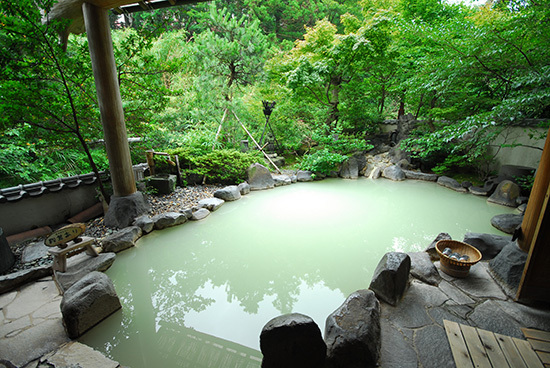
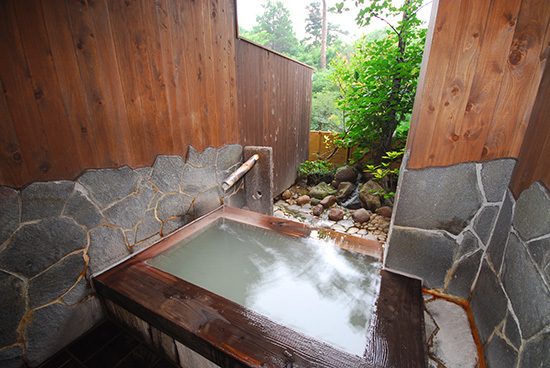
| Large Public Open-air Bath “Seseragi-no-Yu” | Guest room Open-air Bath at Yama Terrace Bettei “Fuku” |
|---|---|
 |
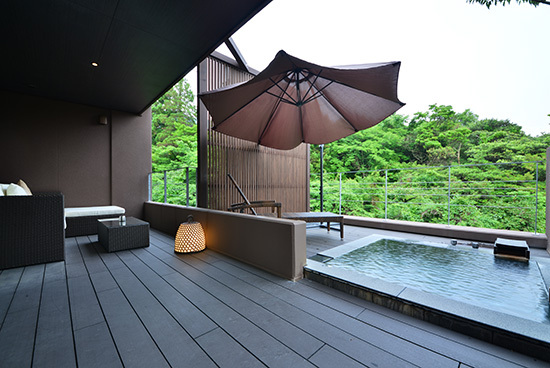 |
| The large public open-air baths are rock baths with a wild atmosphere. Surrounded by lush greenery, the contrast between the cloudy white hot spring water is beautiful. The open atmosphere will allow you to enjoy a superb bathing experience. | The open-air bath in the highest grade guest room “Fuku” at Yama Terrace Bettei. The spacious open-air bath offers a sense of freedom and an “extraordinary” luxury experience. Of course, the source of the spring water is 100% free-flowing, but be careful not to take a long soak. |
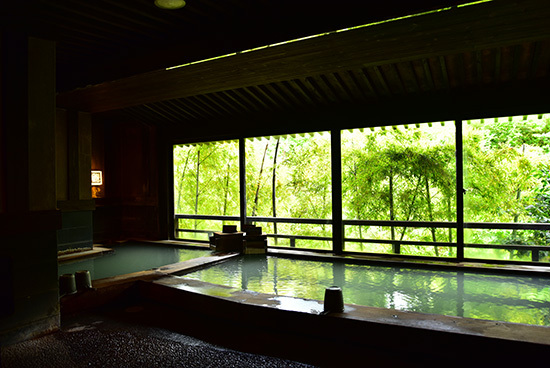
| Large public baths for men and women “Hakuun-no-Yu” | Private bath “Hinoki-no-Yu” |
 |
 |
| The large baths for men and women are named after the mysterious small pond “Hakuun-no-ike” located a 15-minute walk from the inn. The baths are divided into two bathtubs, one hot and one warm, allowing you to bathe at the temperature of your choice. | A half-open-air type private bath with a roof. The hinoki cypress bathtubs create a relaxing atmosphere. Reservations are required for overnight guests, and they are available free of charge. |
Facility Report
Unzen Onsen is located in the central part of Shimabara Peninsula in Nagasaki Prefecture. The Unzen Onsen is said to have been founded in 701 by the itinerant monk Gyōki (668-749), who built Manmyouji Temple. The first inn in Unzen was established in 1695, and the hot spring area was developed in the mid-Edo period (1603-1868). At the end of the Edo period, Shoin Yoshida, known as the leader of the Meiji Restoration, visited Unzen for a hot-spring cure. It was also introduced overseas by Siebold, Kembel, and others, and came to be recognized worldwide.
The symbolic place of Unzen is the Unzen Jigoku (Hell). Hot spring water and fumaroles of steam gush out from everywhere, and the strong smell of sulfur is in the air. The “Unzen Fukudaya/Yama Terrace Bettei” is located just a short distance from Unzen Jigoku.
This inn is relatively small among the large ryokans that line the streets of Unzen Onsen, but its excellent service is often said to be the best in Unzen.
All of the hot springs are 100% free-flowing and have a rich components. The source of the hot spring water gives you a feeling of the power of the earth, as if you can call up the power of your body when you bathe in the water.
The cuisine is also of a high level. The Shimabara Peninsula is sometimes called “Japan's stomach” (by the way, the Shimabara Peninsula is shaped just like a stomach), and the quality of the ingredients, both from the sea and from the fields, is high. Dinners are richly varied, using an abundance of seasonal ingredients.
The entire inn is filled with a warm atmosphere that makes guests feel at home. Families, families with small children, young couples, couples, and female groups for sightseeing purposes all stay here. “Fukudaya” is the first letter of “Furo de yukkuri (in the bath)”, “Kutsuroide (relaxing)”, “Daremoga nagomu (everybody is at ease)”, and “Yado ga Fukudaya (in the Fukudaya)”. The catchphrase “Fukudaya” is truly suitable for this inn.
Recently, “Yama Terrace Bettei”, a luxurious guest room with an open-air bath, was created, attracting a great deal of attention.
The guest rooms in the main building have also been renovated one after another, giving the impression that the number of repeat guests is increasing rapidly. The inn's cozy and modern design stimulates a sense of “fun” and “excitement”.
The owner, Tsutomu Fukuda, is always thinking of new services based on the hot spring and how to make guests happy, and he puts them into action. One night is not enough. “Unzen Fukudaya/Yama Terrace Bettei” is definitely a new wind for Unzen Onsen.
Travel Journal
Rates Data
| 1 night/2 meals fee | From 16,709 yen |
|---|---|
| 1 night/1 meal(breakfast) fee | No settings |
| 1 night/no meal | From 9,702 yen |
| Stay alone | From 23,392 yen |
| Private bath fee when overnight stay |
Free for overnight guests |
| Day stay | Adult: 1,000 yen Child: 500 yen (free for under 3) |
| Private bath for day-stay |
“Hinoki-no-Yu” :1,500 yen “Santaro-no-Yu”: 1,000 yen |
Facility Data
| Establishment | Established in 1968 |
|---|---|
| Check-In | 3:00 p.m. |
| Check-Out | 10:00 a.m. |
| Location and Environment | Mountain, Town |
| Number of Rooms | All 34 rooms |
| Number of People Accommodated |
100 persons |
| Parking Area | Available for 50 cars |
| Facilities | Store, Cafe, Bar, Table Tennis Corner, Private gymnasium |
| Internet | Wi-Fi available |
| Barrier Free | Not supported |
| Toilet with washer | Equipped |
Transportation Access
| By train | ・By airplane Nagasaki Airport - Unzen by bus via Obama (about 115 min.) ・By JR train JR Isahaya Station - Unzen, Obama, Kuchinotsu direction bus to "Unzen" (about 75 minutes) |
|---|---|
| Shuttle bus | None |
| By car | From Hakata・・・Nagasaki Expressway - Isahaya IC - Route 57 (2 hours and a half) From Kumamoto・・・Board a ferry at Kumamoto Shinko - Shimabara Port - Route 57 (2 hours) |
| Address | Nagasaki/Unzen Onsen/Unzen Fukudaya/Yama Terrace Bettei 380-2 Unzen, Obama-cho, Unzen city, Nagasaki 854-0621, JAPAN Phone:+81-(0)957-73-2151 |
- Data
- Jan. 28, 2026