Mogami Takayu Zenshichi-no-Yu
| Acidic, Sulfur containing-Aluminum-Sulfate / Chloride Springs | pH |
|
| 酸性・含硫黄-アルミニウム-硫酸塩・塩化物泉 | ||
| (Hypotonic, Acidic, High temperature spring) | ||
| 旧泉質名:含明礬・食塩―酸性硫化水素泉 | ||
Ideal for:
- People with skin conditions (e.g., atopic dermatitis, eczema)
- People sensitive to cold
- People concerned about dark spots
- People wanting firm, radiant skin
- People feeling stressed
- People seeking beautiful skin
- People with lifestyle-related conditions (e.g., diabetes)
- People with dry skin
- People concerned about minor cuts
- Address
- 825 Zao Onsen, Yamagata-shi, Yamagata, 990-2301, JAPAN
- TEL
- +81-(0)23-694-9422

Official Website
Hot Spring Power Chart (5-point scale)
Hydrogen Ion Concentration (pH)

- Comment
- Strong bactericidal hot spring with a slight tingling sensation
Hot spring Specification
※This is an easy-to-understand expression based on the indications for each type of spring in the “Guidelines for the Mineral Spring Analysis Methods” revised in July 2014 by the Ministry of the Environment.
| ①Mental recovery | ②Insomnia | ③Promote blood circulation | ④Sensitivity to cold | ⑤Dry skin |
| ⑥Cuts | ⑦Skin diseases | ⑧Hypertension (mild) | ⑨Heartburn (drinking) | ⑩Gastrointestinal disorders (drinking) |
| ⑪Constipation (drinking) | ⑫Lifestyle-related disease | ⑬Diabetes | ⑭Gout | ⑮Countermeasures against metabolic syndrome |
| ⑯Biliary system anxiety (drinking) | ⑰Anaemia | ⑱Arthritis rheumatica | ⑲Spinal pain | ⑳Improved immunity |
| ㉑Muscle pain・Neuralgia | ㉒Mild asthma | ㉓Hemorrhoidal pain | ㉔Recovery from an illness | ㉕Recovery from fatigue |
- ※Note①・・・Indications for each spring include autonomic instability and depression.(Simple springs・Chloride springs・Carbon dioxide springs)
- ※Note③・・・Indications for each spring include peripheral circulatory failure(Chloride springs・Carbonate springs・Carbon dioxide springs・Hydrogen sulfide type sulphur spring)
- ※Note④・・・Indications for each spring include sensitivity to cold(Chloride springs・Carbonate springs・Sulfur springs・Carbon dioxide springs)and Iron containing springs
- ※Note⑦・・・Indications for each spring include xeroderma, atopic dermatitis, plaque psoriasis, epidermoid suppuration, chronic eczema(Chloride springs・Carbonate springs・Sulfate spring・Acidic springs・Sulfur springs)
- ※Note⑨・・・Indications for drinking each spring include reflux esophagitis(Carbonate springs)
- ※Note⑩・・・Indications for drinking each spring include atrophic gastritis, gastroduodenal ulcerations(Chloride springs・Carbonate springs)
- ※Note⑪・・・For drinking, Chloride springs and Sulfate spring
- ※Note⑫・・・Indications for each spring include hypercholesterolemia, diabetes, gout(for bathing, Acidic springs・Radioactive springs/for drinking, Carbonate springs・Iodine containing springs・Sulfur springs)
- ※Note⑮・・・Indications for drinking each spring include hypercholesterolemia(Sulfate spring・Iodine containing springs・Sulfur springs)
- ※Note⑱⑲・・・Indications for each spring include rheumatoid arthritis, ankylosing spondylitis(Radioactive springs)
- ※Note⑳・・・Radioactive springs
- ※Note㉑㉔・・・Simple hot spring water is suitable for rehabilitation due to its low level of stimulation, and although it is not listed as an indication by spring quality, it is also called “Hot spring for neuralgia” and “Hot spring for stroke”.
| Applicable to indications by spring quality | Applicable to general indications |
7 Elements of Hot Springs for Beautiful Skin
Total 5 Points ※The number of points represents the quality of the “Hot springs for beautiful skin”.
| Skin cleansing effects | Anti-wrinkle and skin revitalizing effects | Skin whitening and spot prevention effects |
|---|---|---|
| Hydrogen carbonate springs | Sulfate springs | Sulfur springs |
| Skin smoothing effects | Skin coating and moisturizing effects | Dewy and moisturizing effects | Cleaning effects |
|---|---|---|---|
| (Weakly) Alkaline springs | Chloride springs | Metasilicic acid(more than 100 mg/kg) | Metaboric acid(more than 10 mg/kg) |
- ※The “Four Best Beauty Springs” are said to be “Carbonate springs”, “Sulfate springs”, “Sulfur springs”, and “(Weak) Alkaline simple hot springs”.
- ※The “Chloride springs” coats the skin with a salt pack, keeping it warm and moisturized at the same time. It is also called “Hot spring for finishing touch” to be taken after the “Hot spring for beautiful skin” in which exfoliation has been removed.
- ※Hot springs containing 100 mg/kg or more of metasilicicic acid have an excellent moisturizing effect and is said to be “Hot spring for beautiful skin”.
- ※Hot springs containing 10 mg/kg or more of metaboric acid have a cleansing effect, is used in some eye drops, and is said to be effective in treating acne.
Water texture while bathing (5-point evaluation)
| Smooth |  |
 |
|
|
|
Velvety | |
|
|
|
|
|---|---|---|---|---|---|---|---|---|---|---|---|
| Satiny | |
|
|
|
|
Supple | |
|
|
|
|
| Fizzy | |
|
|
|
|
Tingling | |
|
|
|
|
 Indoor bath in Large Public Bath Indoor bath in Large Public Bath |
|||||||||||
Skin feeling after bathing (5-point evaluation)

| Silky | |
|
|
|
|
Dryness | |
|
|
|
|
|---|---|---|---|---|---|---|---|---|---|---|---|
| Satiny | |
|
|
|
|
Sticky | |
|
|
|
|
| Dewy | |
|
|
|
|
Warming | |
|
|
|
|
| Indoor bath in Large Public Bath |
|||||||||||
View from the open-air bath (5-point evaluation)

 View View |
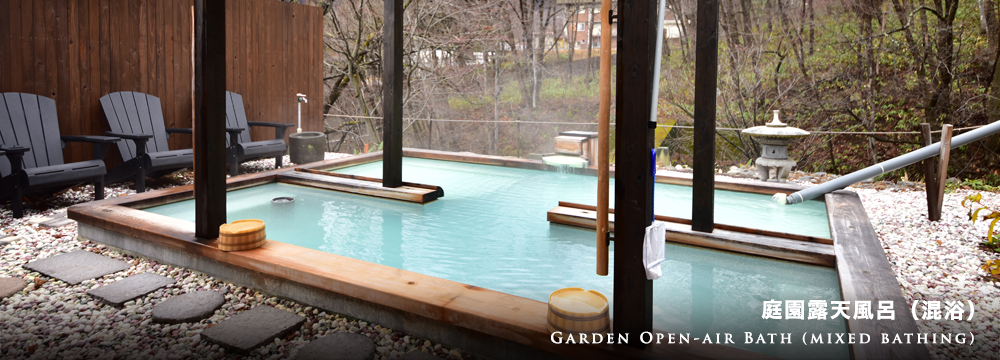
Surrounded by trees, enjoy the feeling of soaking in an open-air bath deep in the mountains |
|---|
| Bath |
Garden Open-air Bath (mixed bathing) |
|---|
 |
|
|
|
Point 4 |
|---|
Hot Spring Source Usage
| Water added No |
Heated No |
Disinfected No |
Circulated No |
Bath additive No |
|---|---|---|---|---|
| ○ | ○ | ○ | ○ | ○ |
| ※100% free-flowing hot spring water. All baths are not circulated, filtered, or disinfected. | ||||
| Percentage of hot spring source |
100% | ||||
|---|---|---|---|---|---|
| Replacement frequency of hot spring water | Large public bath, Garden open-air bath, Private open-air bath: Once a week Guest room open-air bath: Every guest |
||||
| Yield of hot spring water |
Natural gushing | ||||
| Distance from the source to the bathtub |
Large public bath: 5–13 m Private open-air bath: 5–85 m Guestroom open-air bath: 30 m |
||||
| How hot spring water is drawn | Drawn by a pipe | ||||
| Drinking spring | Cannot | ||||
| “Gensen-Kakenagashi” Bath | All baths | ||||
Hot Spring Composition TableHot Spring Analysis Report
| Spring Quality | Acidic, Sulfur containing-Aluminum-Sulfate / Chloride Springs (Hypotonic, Acidic, High temperature spring) 旧泉質名:含明礬・食塩―酸性硫化水素泉 |
|---|---|
| Color of hot spring | Milky white color |
| Scent of hot spring | Sulfur smell |
| Dissolved substances | 3,432 mg/kg ※Components are about 22 times more than commercial bath additives! (Sum of components (1) + (2) + (3), excluding gaseous substances) |
| Temperature of spring | 51.9℃ (5℃ at the time of the survey) |
| pH | 1.7 (Strongly acidic) |
| Yield | About 340 liters per minute Amount of hot spring use per person (yield / bath capacity):About 2.65 liters/person(maximum capacity of 128 people) |
Hot Spring Composition (Amount contained in 1 kg of spring)
 |
|||
|---|---|---|---|
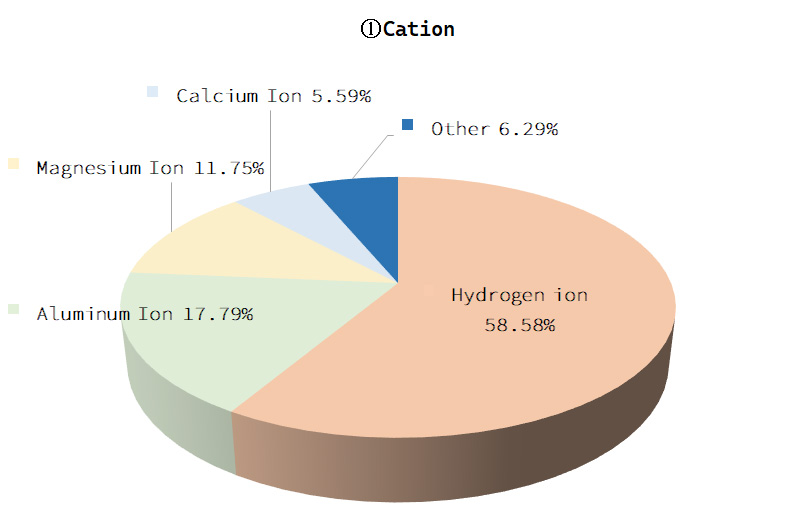
| ①Cation | mg | mval | mval% |
| Hydrogen ion (H+)★ | 20.0 | 19.84 | 38.61 |
| Aluminum Ion (Al3+) | 124.7 | 13.87 | 26.99 |
| Magnesium Ion (Mg2+) | 97.2 | 8.00 | 15.57 |
| Calcium Ion (Ca2+) | 103.3 | 5.15 | 10.02 |
| Sodium Ion (Na+) | 68.7 | 2.99 | 5.82 |
| Potassium Ion (K+) | 29.0 | 0.74 | 1.44 |
| Ferro Ion (Fe2+)★ | 17.8 | 0.64 | 1.25 |
| Manganese Ion (Mn2+) | 4.2 | 0.15 | 0.29 |
| Zinc Ion (Zn2+) | 0.4 | 0.01 | 0.02 |
| Cations Total(1) | 465.3 | 51.39 | 100.00 |
 |
|||
|---|---|---|---|
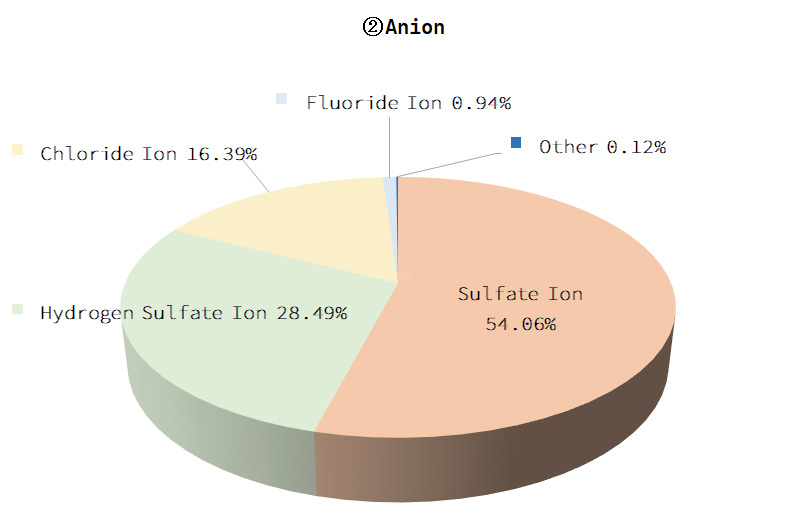
| ②Anion | mg | mval | mval% |
| Sulfate Ion (SO42-)★ | 1309.0 | 27.26 | 54.13 |
| Chloride Ion (Cl-)★ | 471.4 | 13.30 | 26.41 |
| Hydrogen Sulfate Ion (HSO4-) | 879.9 | 9.07 | 18.01 |
| Fluoride Ion (F2-)★ | 13.2 | 0.69 | 1.37 |
| Bromine Ion (Br-) | 2.5 | 0.03 | 0.06 |
| Iodide Ion (I2-) | 0.7 | 0.01 | 0.02 |
| Anion Total(2) | 2676.7 | 50.36 | 100.00 |
| ③Non-dissociated Components | mg | mmol | |
|---|---|---|---|
| Metasilicic Acid (H2SiO3)★ | 238.4 | 3.05 | |
| Metaboric Acid (HBO2)★ | 6.9 | 0.16 | |
| Free Sulfuric acid (H2SO4) | 44.3 | 0.45 | |
| Non-dissociated Components Total(3) | 289.6 | 3.66 | |
| Dissolved Gas Components | mg | mmol | |
|---|---|---|---|
| Free Carbon Dioxide (CO2)★ | 379.0 | 8.61 | |
| Free Hydrogen Sulfide (H2S)★ | 6.6 | 0.19 | |
| Dissolved Gas Components Total(4) | 385.6 | 8.8 | |
| Other Trace Components | |||
|---|---|---|---|
| Not specified |
★are the components related to the “spring quality” and the components that qualify conditions for “Hot spring” and “Therapeutic hot spring”.
Indications by Spring Quality for Bathing (Revised on July 1, 2014)
Plaque psoriasis, Impaired glucose tolerance (diabetes), Epidermal suppuration, Atopic dermatitis, Chronic eczema, Cuts, Peripheral circulatory disturbance, Sensitivity to cold, Depression, Dry skin
General Indications for Bathing (Revised on July 1, 2014)
Chronic pains or stiffness of muscles or joints (chronic phase of rheumatoid arthritis, osteoarthritis, lower back pain, nerve pains, frozen shoulder, bruises, sprains, etc.),
Muscle stiffness by motor paralysis, Sensitivity to cold, Peripheral circulatory disturbance,
Gastrointestinal hypofunction (slow digestion, intestinal gas formation, etc.),
Mild hypertension, Impaired glucose tolerance (diabetes), Mild hypercholesterolemia,
Mild asthma or Emphysema, Hemorrhoidal pains, Autonomic instability,
Various symptoms from stress (sleep disorders, depression, etc.),
Restorative phase from illness, Recovery from fatigue, Health promotion
Contraindications by Spring Quality for Bathing (Revised on July 1, 2014)
Sensitive skin or mucous membranes, dry skin in the elderly
General Contraindications for Bathing (Revised on July 1, 2014)
Active stage of diseases (especially when fever is accompanied), Active tuberculosis,
Advanced malignant tumor, or the case of significant debility involving severe anemia,
Severe cardiac or lung diseases involving suffocation feelings with a little movement,
Severe kidney disease involving edema, Gastrointestinal bleeding,
When bleeding is visible, Acute exacerbation stage of chronic diseases, etc.
Indications by Spring Quality for Drinking
※Not drinkable
Date of Analysis (The above hot spring composition table is cited from the survey data of the following institution)
November 1, 2014 (Tanno Corporation)
- ※Indications and contraindications for hot springs are in accordance with “Guidelines for the Mineral Spring Analysis Methods” revised on July 1, 2014.
- ※Data was provided by the inn.
20 qualifications for “Hot spring” and 8 qualifications for “Therapeutic hot spring”
| Conditions / Components (contained amount in 1kg) ※If even one of the conditions is cleared, it is a “Hot spring” or “Therapeutic hot spring” |
A【Hot Springs Act】 Conditions of the “Hot spring” |
B【The Guideline for analysis of Kosen】 Conditions of the “Therapeutic hot spring” |
|
|---|---|---|---|
| 1 | Temperature (when collected from source) | 25℃ or more | |
| 2 | Dissolved Substances (excluding gaseous) | Total amount 1,000 mg or more | |
| 3 | Free Carbon Dioxide (CO2) | 250 mg or more | 1000 mg or more (Carbon dioxide springs) |
| 4 | Lithium Ion (Li+) | 1 mg or more | ― |
| 5 | Strontium Ion (Sr2+) | 10 mg or more | ― |
| 6 | Barium Ion (Ba2+) | 5 mg or more | ― |
| 7 | Total Iron Ion[Fe2+(Iron(Ⅱ) Ferro Ion)+Fe3+(Iron(Ⅲ) Ferri Ion)] | 10 mg or more | 20 mg or more (Iron containing springs) |
| 8 | First Manganese Ion (Mn2+) | 10 mg or more | ― |
| 9 | Hydrogen Ion (H+) | 1 mg or more | 1 mg or more (Acidic springs) |
| 10 | Bromine Ion (Br-) | 5 mg or more | ― |
| 11 | Iodide Ion (I-) | 1 mg or more | 10 mg or more (Iodine containing springs) |
| 12 | Fluoride Ion (F-) | 2 mg or more | ― |
| 13 | Hydro Arsenate Ion (HAsO42-) | 1.3 mg or more | ― |
| 14 | Meta-arsenic Acid (HAsO2) | 1 mg or more | ― |
| 15 | Total sulfur (S) [HS-(Hydrogen Sulfide Ion)+S2O32-(Thiosulfate Ion)+H2S(Free Hydrogen Sulfide)] | 1 mg or more | 2 mg or more (Sulfur springs) |
| 16 | Metaboric Acid (HBO2) | 5 mg or more | ― |
| 17 | Metasilicic Acid (H2SiO3) | 50 mg or more | ― |
| 18 | Sodium Hydrogen Carbonate (Sodium Bicarbonate) (NaHCO3) |
340 mg or more | ― |
| 19 | Radon (Rn) | 20 or more (unit: ten ppb curie) 20×10-10Ci(curie) or more 20 or more(ten ppb curie) =74Bq(becquerel) / 5.5mache or more |
30 nanocurie or more (Radioactive springs) 30×10-10Ci(curie) or more 30 or more(ten ppb curie) =111Bq(becquerel) / 8.25 macheor more |
| 20 | Radium Salt (as Ra) | 10-8 mg or more 1/100 million mg or more |
― |
| Number of conditions cleared this “hot spring” or “therapeutic hot spring” is: | 8 (out of 20) | 4 (out of 8) | |
| Total 12 Points | |||
※The conditions for a “hot spring” in Japan are expressed in points.
Hot Spring Legends and More
Traditionally documented efficacies
Skin disease, Skin whitening
Historical figures who bathed in this hot spring
ー
Celebrities who bathed in this hot spring
Sara Takanashi (Women's Ski Jumping)
Hot Spring (Onsen) Report
This inn is strongly impressed with its commitment to hot springs, even among Zao Onsen, which has a reputation for the quality of its springs. One of their passion for hot springs can be seen in the way of using the hot spring water. The baths are not circulated, filtered, or disinfected, but are always filled with fresh hot spring water, which is natural free-flowing hot spring water, and then overflowed to be replaced by new hot spring water. The temperature is adjusted by blending two different temperatures of hot spring sources, taking into account the temperature of the day, to create the right temperature. Guests can experience a “handmade” 100% free-flowing hot spring water.
It is also important to note that it is a private hot spring source. Hot spring water, like any other substance, begins to oxidize (deteriorate) when it comes into contact with the air. In other words, the shorter the distance from the source well to the bathhouse, the fresher the hot spring water. It is a great advantage to have the source well on the same site. Another advantage is that the spring source is naturally gushing, without the use of a motor to pump up the hot water. This means that the source is located close to the surface of the earth, and the hot spring water gushes out from there without the use of machinery to pump it up. Because of this, there is less chance of impurities being mixed in. This is a feature of Zao Onsen as a whole, but it is also a testament to the long history of this hot spring area, which dates back to a time when machines did not exist.
The amount of dissolved substances, which indicates the character of the hot spring, is extremely rich at 3,432 mg/kg, which is also one of the features of the hot spring.
The spring quality is “Acidic, Sulfur containing-Aluminum-Sulfate / Chloride Springs”. To put it simply, it is a hot spring that has four of the ten spring qualities that are currently classified: “Acidic springs”, “Sulfur springs”, “Sulfate springs” and “Chloride springs”.
First, one of the conditions for “Acidic springs” is that 1 kg of hot spring water must contain at least 1 mg of hydrogen ions. This hot spring contains 20 mg/kg of hydrogen ions, which account for 38.61 mval%. As indicated by its pH value (hydrogen ion concentration) of 1.7, it is strongly acidic.
It is said to be “Hot springs for skin diseases” because it has very high antibacterial power and removes a wide range of causes of problems on the surface of the skin. Also effective against athlete's foot. And it is said to be good for sterilizing Staphylococcus aureus, one of the causes of Atopic dermatitis. This is because Staphylococcus aureus can be inhibited from reproducing in an acidic environment.
Other indications for spring quality include Plaque psoriasis, Impaired glucose tolerance (diabetes), and Epidermal suppuration. It is also said to be effective against Tinea (ringworm), Trichomonas vaginalis, and Scabies.
Next, as for “Sulfur springs”, one of the conditions is that 1 kg of hot spring water contains 2 mg or more of total sulfur (the sum of (1) Hydrogen sulfide ions, (2) Thiosulfate ions, and (3) Free hydrogen sulfide). There are two types of Sulfur springs: Sulfur-type springs, which contain mainly (1) + (2), and Hydrogen sulfide-type springs, which contain more (3). Here at Zao Onsen, the water is a “Hydrogen sulfide-type Sulfur springs”.
The spring water is milky white in color, and has many indications in common with “Acidic springs”, including Atopic dermatitis, Plaque psoriasis, Chronic eczema, and Epidermal suppuration. In addition, Hydrogen sulfide-type Sulfur springs are also considered effective for peripheral circulatory disturbances.
The Sulfur springs, like the Acidic springs, has a high antibacterial effect, so it is said to be “Hot springs for skin diseases” that is effective for all kinds of skin surface problems. In addition, sulfur springs remove excess sebum, making them ideal for people prone to acne and oily skin, and since they suppress the production of melanin, the substance that causes skin spots, it is also called “Hot springs for preventing skin spots” and can be expected to have a whitening effect as well. In other words, Sulfur springs is a typical “Hot springs for beautiful skin”. The reducing effect of sulfur also reacts with active oxygen, a substance that causes aging, so a rejuvenating effect can be expected.
In addition, it is sometimes called “Hot springs for phlegm” because of its effectiveness in relieving asthma and improving the sharpness of phlegm.
One thing to keep in mind is that metal items such as rings and necklaces can discolor due to sulfur components, so remember to remove them when bathing.
Contraindications by spring quality for bathing include sensitive skin or mucous membranes, and dry skin in the elderly (*same as Acidic springs). In other words, “Sulfur springs”, like “Acidic springs”, are highly stimulating springs, so the sickly, elderly, and those with sensitive skin should be careful and are prone to “Hot spring fatigue (yu-atari)”. Many of the best hot springs are a combination of “Acidic” (antibacterial) and “Sulfur (hydrogen sulfide-type)” (skin-beautifying) springs. However, please keep in mind that the stronger the efficacy, the more stressful it is on the skin.
One of the conditions for “Sulfate springs” is that the main component of the anion is a sulfate ion.
Sulfate ions have antibacterial and anti-inflammatory properties, helping to ease cuts, joint pain, muscle soreness, and other forms of pain or inflammation. For this reason, such springs are known as “Hot springs for cuts”. They also help dilate blood vessels and increase the amount of oxygen carried in the blood, which is why they are sometimes called “Hot springs for stroke prevention”. This improves circulation in peripheral parts of the body, such as the hands and feet, where blood flow tends to stagnate. As a result, they are helpful for sensitivity to cold and peripheral circulatory disturbances. These circulation-enhancing and calming effects help regulate the autonomic nervous system, reduce stress, stabilize the mind, and may even help improve depression. In addition, sulfate springs help soften the skin’s keratin layer, allowing moisture to penetrate and improving dry skin. They also promote collagen production, support skin renewal, and stimulate metabolism. Because they help restore firmness and moisture to the skin with noticeable anti-aging benefits, they are often called “Hot springs for rejuvenation” and “Hot springs for beautiful skin”.
The sulfate ion, which is an anion, combines here with the cation aluminum ion to form an Aluminum-Sulfate spring. Under the former classification system, it was called “alum spring”. Although aluminum ions were removed from the qualifying criteria for hot springs in the 2014 revision of the Guidelines for the Mineral Spring Analysis Methods, Aluminum-Sulfate springs have long been known for their astringent effect, which tightens the skin and mucous membranes by denaturing proteins. They were considered beneficial for chronic skin conditions such as athlete’s foot and eczema, as well as for conditions like trichomonal vaginitis.
One of the conditions for classifying a hot spring as a “Chloride springs” is that chloride ions are the main anions.
The indications for bathing based on spring quality are similar to those of sulfate springs and include cuts, peripheral circulatory disturbances, sensitivity to cold, depression, and dry skin. The most distinctive feature of “Chloride springs” is that when you bathe in them, the salt content coats the body like a pack. This pack blocks the sweat glands, slowing the drop in body temperature after bathing and allowing the warmth to last much longer. For this reason, “Chloride springs” are also known as “Hot springs for warmth”. Although other spring types may also be indicated for sensitivity to cold, “Chloride springs” are considered particularly effective.
At the same time, the long-lasting warmth helps improve peripheral circulatory disturbances. The salt pack also helps prevent dry skin after bathing because its coating effect enhances the retention of hot spring minerals and provides moisturizing benefits.
The sustained warming effect helps the autonomic nervous system remain balanced, which contributes to a sense of mental stability. In addition, the rise in body temperature suppresses the secretion of stress hormones, which may help improve mood and offer benefits for depression.
Furthermore, when “Chloride springs” are used after bathing in “Hot springs for beautiful skin”, such as Weak alkaline simple springs, Hydrogen carbonate springs, Sulfate springs, or Sulfur springs, which help remove old keratin from the skin, the salt coating and moisturizing effects act as a finishing touch. For this reason, “Chloride springs” are sometimes referred to as “Hot springs for finishing touch”.
The bactericidal effect of the salt also makes chloride springs effective for cuts and burns, and they are sometimes called “Hot springs for cuts”.
Here, we would like to explain the components that meet the qualifying criteria for hot springs, even though they are not reflected in the official spring classification.
First, among the cations, the water contains as much as 17.8 mg/kg of ferro ions. A concentration of 10 mg/kg meets the qualification standard for hot springs, and 20 mg/kg or more upgrades a spring to a ferrous spring, so this one is almost considered a ferrous spring. Before the 2014 revision, ferrous springs whose main component was the ferro ion were believed to be effective for conditions commonly seen in women, such as anemia, menopausal symptoms, menstrual disorders, and sensitivity to cold. After the revision, however, they were removed from the list of indications by spring quality because of insufficient scientific evidence. Nevertheless, the combined effects with other types of springs, such as sulfur springs and chloride springs, allow for a certain degree of warming effect to be expected.
Next, the spring water also contains 13.2 mg/kg of fluoride ions, far exceeding the hot spring qualification standard of 2 mg/kg. Fluoride ions (fluorine) are commonly found in toothpaste and are known to strengthen tooth enamel and help prevent cavities. In bathing, they are said to support the astringent effects of components such as aluminum ions, which tighten the skin and mucous membranes, and they are expected to provide analgesic and soothing benefits for joint pain and neuralgia.
Attention should also be given to the amount of metasilicic acid, a non-dissociated component separate from cations and anions. The spring water contains 238.4 mg per kilogram, which is nearly five times the qualification standard for hot springs (50 mg/kg). Metasilicic acid is known for its moisturizing properties and is even used as an ingredient in certain lotions. When its concentration exceeds 100 mg/kg, the moisturizing effect becomes more noticeable, allowing the spring to be regarded as a “Hot springs for beautiful skin”.
Similarly, the spring contains 6.9 mg/kg of metaboric acid, another non-dissociated component, exceeding the qualification standard for hot springs (5 mg/kg). Metaboric acid is known for its cleansing properties and is said to help prevent acne. When its concentration reaches 10 mg/kg or more, it is considered one of the secondary conditions for calling a spring a “Hot springs for beautiful skin”.
Among the dissolved gas components, the spring contains as much as 379.0 mg/kg of free carbon dioxide. This is what we commonly refer to as carbonic gas, and when CO₂ is absorbed through the skin, it triggers vasodilation, which in turn promotes blood circulation. As a result, it is expected to help improve conditions such as high blood pressure, poor circulation, and arteriosclerosis. However, because this hot spring is quite hot, the characteristic carbonic bubbles dissipate and cannot be seen.
Lastly, although this is well known among hot spring critics and researchers, the spring quality of Kusatsu Onsen in Gunma, a symbolic top-class hot spring in Japan, is very similar to that of Zao Onsen. Their pH levels, as well as the types and balance of ions that make up the spring water, are closely aligned. For this reason, some people even refer to Zao Onsen as the “Kusatsu of the North”. However, it should be noted that the amount of dissolved substances contained in one kilogram of water at Zao Onsen is nearly twice that of Kusatsu Onsen.
| Indoor bath in Large Public Bath | Garden Open-air Bath (mixed bathing) |
|---|---|
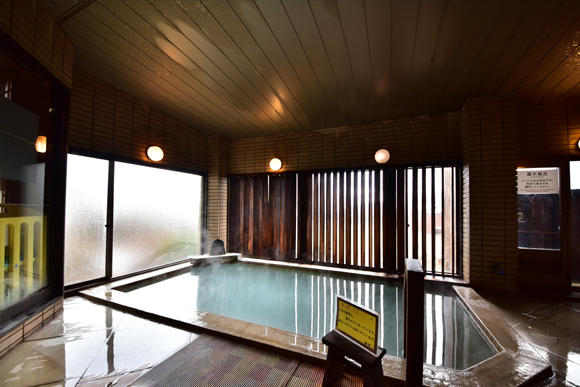 |
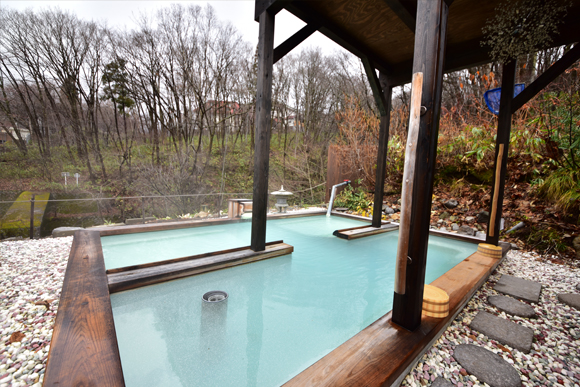 |
| An indoor bath located within the large public bathing area for both men and women. The bath alternates between men and women depending on the time of day. Spring water flows into the tub at a rate of 30 liters per minute, enough to fill this large bath in roughly 15 minutes. It is a signature bath where the owner insists on using only 100% free-flowing hot spring water. | Beyond the large public baths lies the only open-air mixed bathing area in Zao Onsen. Please note that you must borrow a special bathing suit at the front desk before entering. Here, you can enjoy the seasonal scenery such as fresh greenery in spring and summer, colorful foliage in autumn, and snowy views in winter. |
| Private Open-air Bath "Daigokuten" | Private Open-air Bath "Fukurokuju" |
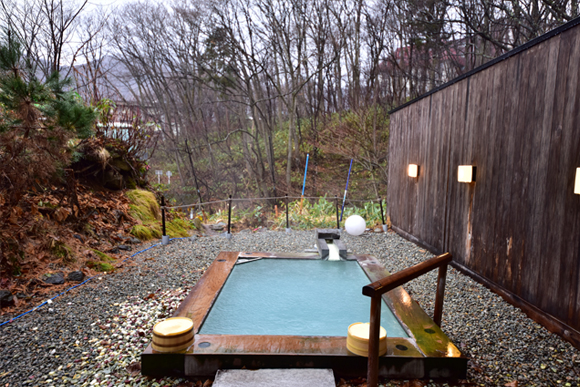 |
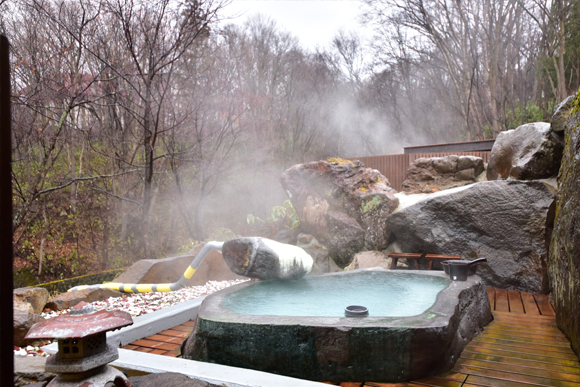 |
| This is one of the private open-air baths that are a hallmark of this inn. It is located closest to the source, allowing you to enjoy the freshest hot spring water. It is a popular bath where you can feel completely at one with nature. | The stone baths blend seamlessly into the natural surroundings and offer a wonderfully rustic atmosphere. The temperature is set slightly lower than the other baths at 41°C. Even so, it is easy to become fatigued from the hot spring, so be careful not to stay in too long. |
Facility Report
Zao Onsen is a hot spring resort located in the southeastern part of Yamagata City, Yamagata Prefecture, at an elevation of 900 meters on the western foothills of the Zao Mountain Range. It is one of the most renowned hot spring areas in the Tohoku region, known not only for its long-established name but also for its abundant hot spring output.
The hot spring is said to have opened around 110 A.D., making it one of the oldest in Japan. In ancient times, Zao Onsen was called Mogami Takayu (now Zao Takayu) and was counted among the “Three Great High-Altitude Hot Springs of Ou”, along with Shirabu Takayu in the same prefecture and Shinobu Takayu in Fukushima Prefecture. “Zenshichi-no-Yu”, the inn featured here, also has a long history, having been founded in the mid-Edo period (1603–1868), giving it a history of more than 300 years.
The inn’s president, Zenshichi Okazaki, the 13th-generation owner, has extensive knowledge of hot springs—reflected in the inn’s name itself. He actively incorporates new information and research into the operation of the inn. When not away on business, he even hosts an “Onsen Classroom” after dinner for guests who wish to attend.
The baths are another highlight. Using an ample supply of private spring sources, the inn offers five private open-air baths. Guests can also enjoy baths exclusively for pets and private saunas. In addition, the property features the only mixed open-air bath in all of Zao Onsen, where bathing suits are required.
The inn has 30 guest rooms in total: 21 Japanese-style rooms, 3 Japanese–Western rooms, and 6 Western-style rooms. There are also pet-friendly rooms, special rooms with popular private open-air baths, and more affordable room types.
Although Zao Onsen is particularly popular in winter for its proximity to ski resorts and its famous juhyo (ice-covered “snow monsters”), many visitors come throughout the year simply to enjoy the hot springs.
Spring brings many cherry blossom viewing spots; June is lively with cherry picking, followed by grape and peach picking in summer. October marks the height of the autumn foliage season.
Meals feature not only delicious local rice but also the highly regarded Yamagata beef and other regional specialties from Yamagata Prefecture, which is known as a “treasure trove of food”.
The inn consistently pays close attention to the needs of its guests and strives to make those wishes a reality. The staff’s hospitality feels natural and unforced, creating a truly comfortable environment. It is easy to understand why so many guests return again and again.
Rates Data
| 1 night / 2 meals fee | From 15,000 yen (tax included) |
|---|---|
| Private bath fee when overnight stay |
Free |
| Day stay bathing | Adults: From 1,000 yen (tax included) Elementary school students and under: 500 yen Preschool children: 0 yen |
| Private bath for day-stay |
Yes |
| Day-stay bathing website | Search by『Zenshichi Kubic』 |
Facility Data
| Establishment | Mid-Edo period (about 300 years ago) |
|---|---|
| Check-In | 3:00 p.m. |
| Check-Out | 10:00 a.m. ※Depending on the plan, 11:00 a.m. |
| Number of Rooms | All 30 rooms (21 Japanese-style rooms / 3 Japanese/Western-style rooms / 6 Western-style rooms) |
| Number of People Accommodated |
128 persons |
| Parking Area | Available for 40 cars |
| Facilities | Shop, Table tennis (fee required), Banquet hall, Barbecue (fee required), Non-smoking rooms, Ice machine, Drying room |
| Internet | Wi-Fi available |
| Barrier Free | Not supported |
| Toilet with washer | All rooms except Western rooms are equipped |
Transportation Access
| By train | From Tokyo area, about two and a half hours. Take the Yamagata Shinkansen and get off at JR Yamagata Station. From JR Yamagata Station, 37 min. by bus for Zao Onsen. Pick-up service is available from the Zao Onsen Bus Terminal to the inn. |
|---|---|
| By car | Tohoku Expressway → get off at Yamagata Zao IC on Yamagata Expressway → about 30 min. using Nishi-Zao Kogen Line. |
| Address | Yamagata / Zao Onsen / Zenshichi-no-Yu 825 Zao Onsen, Yamagata-shi, Yamagata, 990-2301, JAPAN TEL:+81-(0)23-694-9422 |
- Data
- Dec. 24, 2025